Prompted vs. Proven: Five Frontier Models Against Miggo's Mitigation Lab
Miggo's Mitigation Lab (Miggo Lab) outperformed Opus 5.5, Fable 5.1, Gemini 3.1 Pro, GPT-6 Astra and GPT-6.1 Sol on recent High Emerging Threats (HETs). Across 1,757 replayed requests, it stopped 42% more exploits, produced 88% fewer false positives, used half the WAF capacity of the strongest model and delivered a working mitigation for every vulnerability in the set.
Executive Summary
With the emergence of frontier AI models, the time between disclosure and exploitation keeps shrinking, and a team that waits for the patch is just exposed.
The same models also offer an opportunity: paste a CVE into any of them and a proposed mitigation comes back in seconds. However, speed alone does not provide efficient and safe protection. A generated mitigation is only a hypothesis until it has been tested. Before a team can trust it, it must pass three tests:
- Effective: Does it block the exploit, including the variants an attacker tries once the first payload fails? If it misses, the team stays exposed while believing they are protected.
- Safe: Does it leave legitimate traffic alone? If it breaks the application, the application owner will need to roll it back, and then they're back to being exposed and open to breach.
- Efficient: Does it fit the budget? WAF capacity is finite, and an expensive rule crowds out the next one.
So we asked: can a frontier model produce a mitigation you would ship? We put Miggo Lab against five leading frontier AI models on recent vulnerabilities that can be mitigated at the WAF layer, most of them recent High Emerging Threats. Each mitigation ran on its own in AWS WAF against 1,757 requests: 969 validated exploits and 788 legitimate requests built to look like them. Every score comes from the WAF's recorded verdict, never from reading the rule.
The sharpest gap: all five models judged CVE-2026-97229, a CVSS 10.0 GitLab RCE, not blockable at the WAF and wrote no rule. Miggo Lab's rule blocked every exploit request.
We weren't testing who could write a better WAF rule. We were testing who could produce a better mitigation, which is the only outcome that matters: a validated control that protects against exploitation while remediation is underway.
| Measure | What it answers | Miggo Lab | Opus 5.5 | Fable 5.1 | Gemini 3.1 Pro | GPT-6 Astra | GPT-6.1 Sol |
|---|---|---|---|---|---|---|---|
| Overall score (F1) | Does the mitigation hold efficacy and safety at once? | 0.86 | 0.61 | 0.45 | 0.38 | 0.14 | 0.11 |
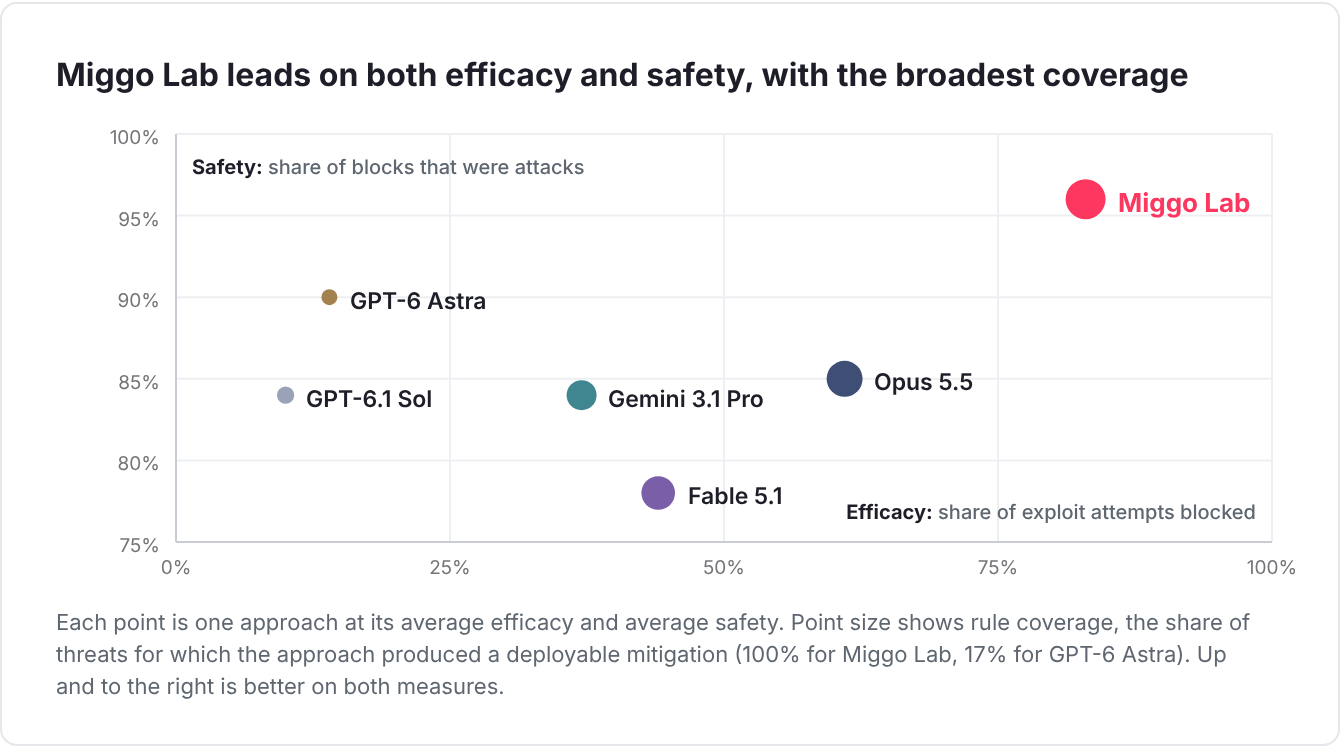
| Efficacy (Recall) | What share of exploit attempts does it block? | 83% | 61% | 44% | 37% | 14% | 10% |
| Safety (Precision) | What share of what it blocks is a real attack? | 96% | 85% | 78% | 84% | 90%* | 84%* |
| Rule coverage | For what share of threats did it produce a deployable mitigation? | 100% | 88% | 79% | 67% | 17% | 21% |
| Control cost (WCU) | How much WAF capacity does a rule consume, in AWS WAF capacity units? Lower is better. | 43 | 85 | 96 | 60 | 22 | 90 |
*Safety is averaged only over the threats where a mitigation ran and blocked at least one request: 100% of threats for Miggo Lab, 88% for Opus 5.5, 75% for Fable 5.1, 54% for Gemini 3.1 Pro, and 17% each for GPT-6 Astra and GPT-6.1 Sol. The GPT-6 Astra and GPT-6.1 Sol figures therefore rest on a small sample.
Key Results
Against five leading frontier models, the research shows Miggo Mitigation Lab leading on both efficacy and safety across the broadest coverage:

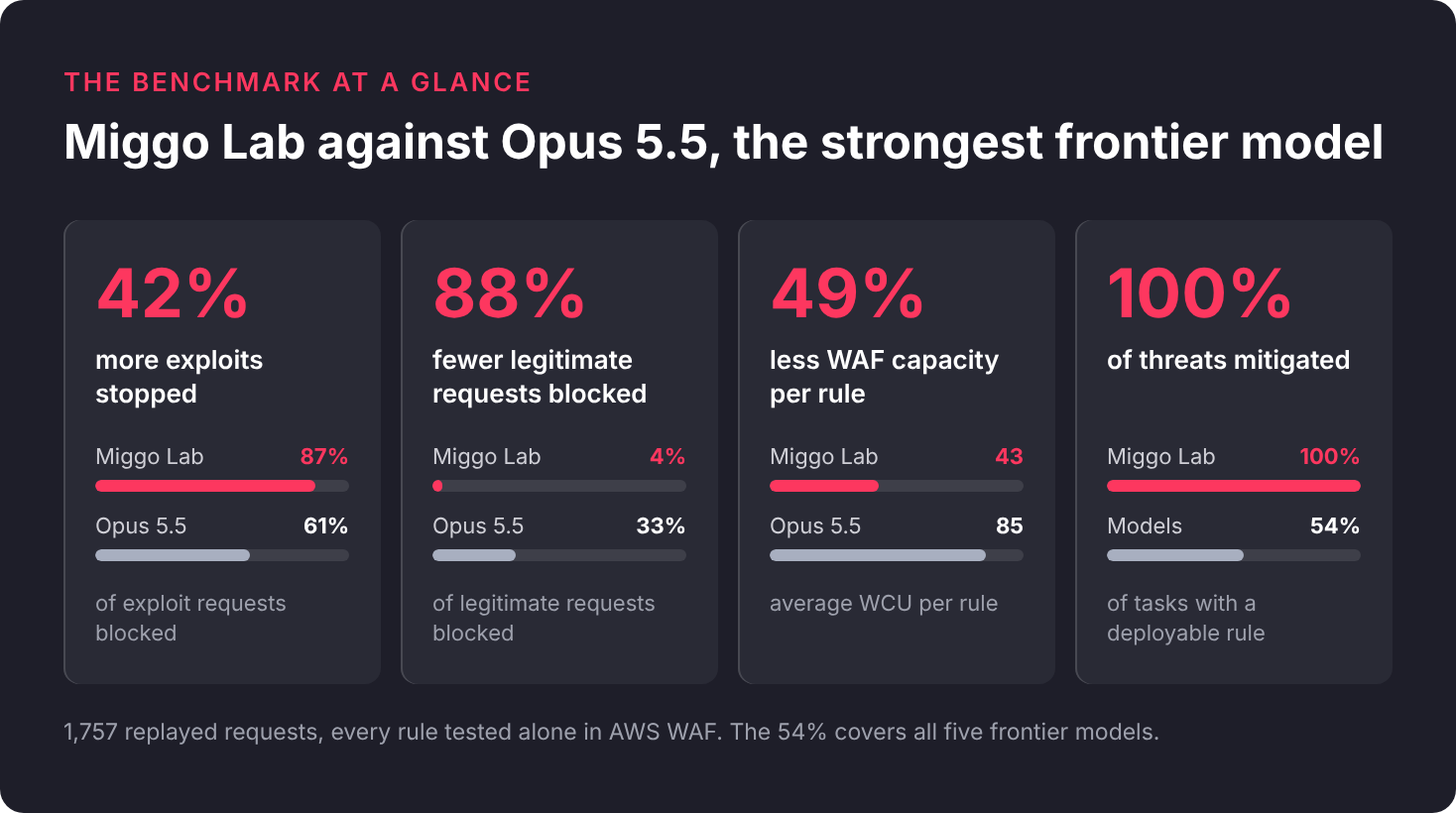
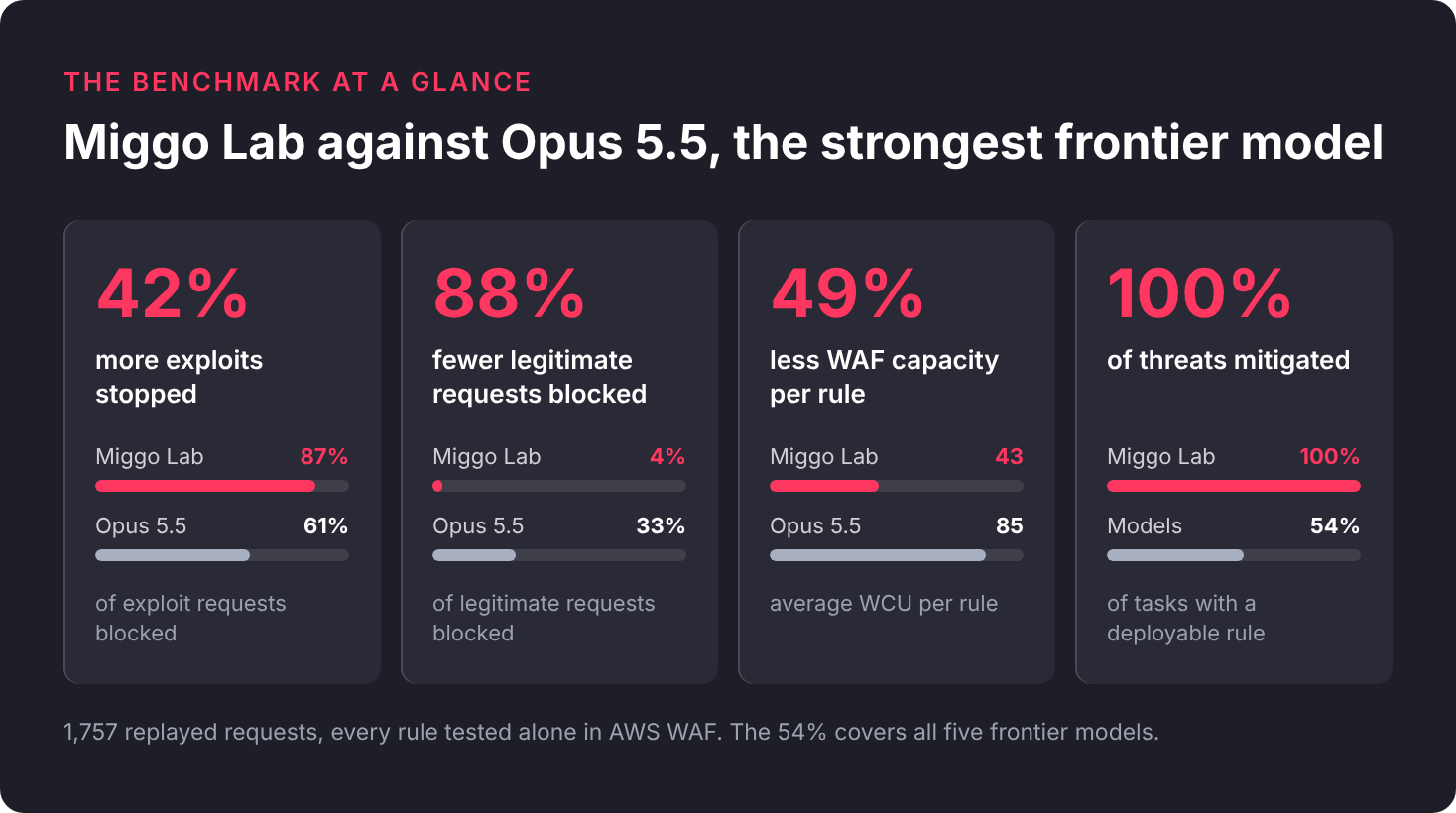
- Most effective: Miggo Lab blocked 87% of all exploit requests, 42% more than Opus 5.5, the strongest model.
- Safest (least false positives): 96% of Miggo Lab blocks were real attacks, 11 points above Opus 5.5, and the Lab blocked 88% fewer legitimate requests.
- Half the WAF capacity: 43 WCU per rule against 85 for Opus 5.5, so the same Web ACL holds about twice as many rules.
- Mitigation Lab provided 100% coverage of every vulnerability: the five models delivered one on 54% of their attempts, and none wrote a rule for CVE-2026-97229, a CVSS 10.0 GitLab RCE the Lab blocked on every exploit request.
The difference isn't a smarter AI model, it's a smarter AI process. A frontier model produces a hypothesis from a CVE identifier. Miggo Lab analyzes the vulnerability, reproduces the exploit, builds attack variations and lookalike traffic, and tests each candidate until the evidence says the rule holds.
Table of Contents
- Executive Summary
- Key Results
- Table of Contents
- Deeper Dive into Key Results
- 1. Most effective: Miggo Lab blocked 87% of all exploit requests, 42% more than Opus 5.5, the strongest model.
- 2. Safest (least false positives): Miggo Lab blocked 88% fewer legitimate requests
- Proven in Your Environment Before It Blocks
- 3. Half the WAF capacity: Miggo Lab used 49% less per rule than the leading model
- 4. Models Produced No Deployable Rule on 46% of Attempts. Miggo Mitigation Lab Covered 100%
- 5. Head to Head: Miggo Lab Matched or Beat Opus 5.5 on 79% of Threats
- 6. What Miggo Lab Does That a Prompt Cannot
- Why This Matters: Mitigate Now, Patch When You're Ready
- Methodology
- Which Threats We Tested
- How the Traffic Was Built
- How Each Mitigation Was Produced
- How Mitigations Were Tested and Scored
- Limits of this Study
- What Comes Next
- Appendix A: Frequently Asked Questions
- Appendix B: Representative Model Refusals
Deeper Dive into Key Results
1. Most effective: Miggo Lab blocked 87% of all exploit requests, 42% more than Opus 5.5, the strongest model.
Efficacy is the first test: does the mitigation block the exploit, including the variants an attacker tries once the first payload fails?
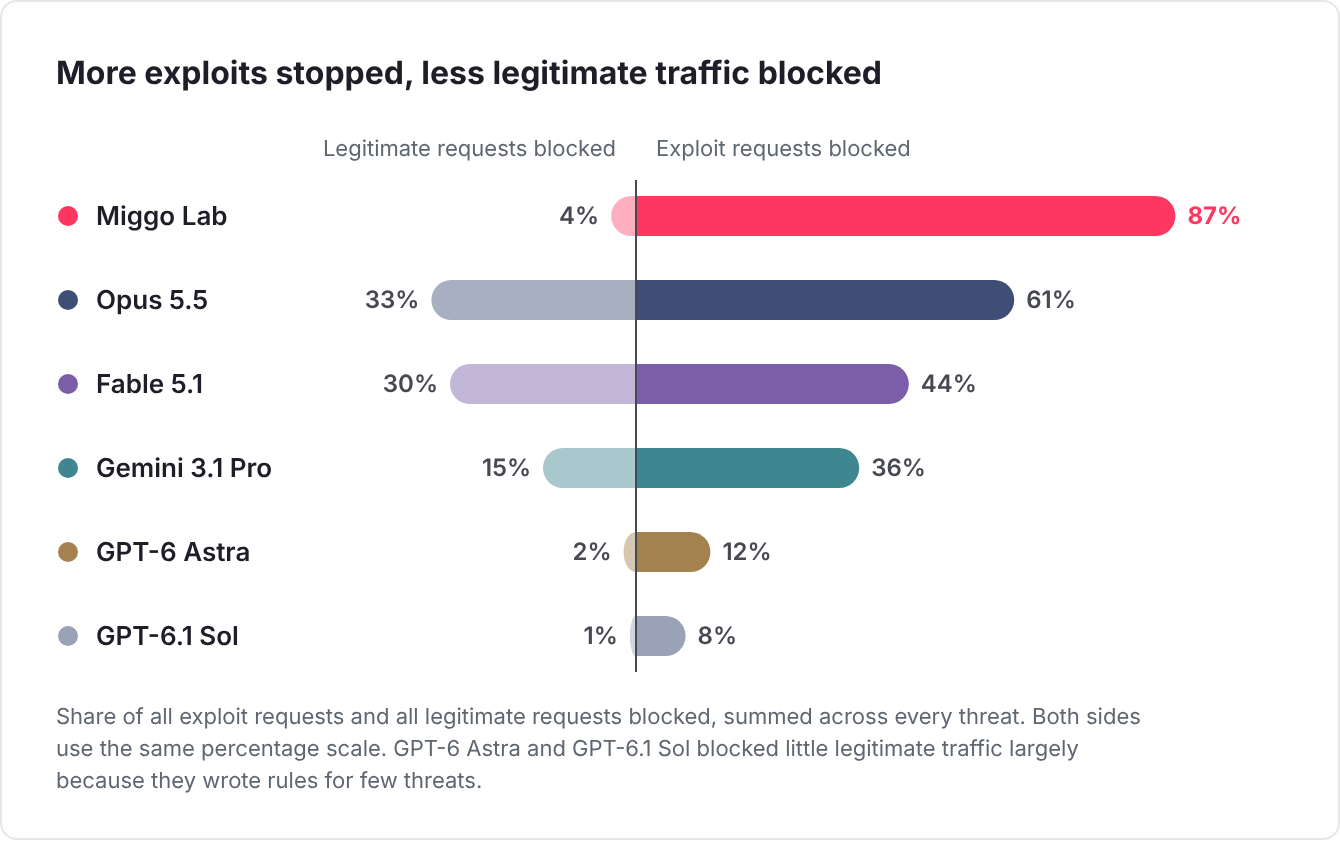
Summed across every threat, Miggo Lab's rules blocked 87% of the exploit requests, compared with 61% for Opus 5.5, the strongest model in the test. That is 42% more attacks blocked and 66% fewer attacks getting through.
Averaged threat by threat, Miggo Lab's rules blocked 83% of each threat's exploit attempts, against 61% for Opus 5.5, 44% for Fable 5.1, 37% for Gemini 3.1 Pro, 14% for GPT-6 Astra and 10% for GPT-6.1 Sol. A declined or rejected rule counts as zero.
2. Safest (least false positives): Miggo Lab blocked 88% fewer legitimate requests
The gap on legitimate traffic is wider. Opus 5.5 blocked 33% of the legitimate requests and Fable 5.1 blocked 30%. Miggo Lab blocked 4%, which is 88% fewer than Opus 5.5. GPT-6 Astra and GPT-6.1 Sol blocked very little legitimate traffic, but largely because they wrote rules for few threats, so they also stopped only 12% and 8% of attacks.
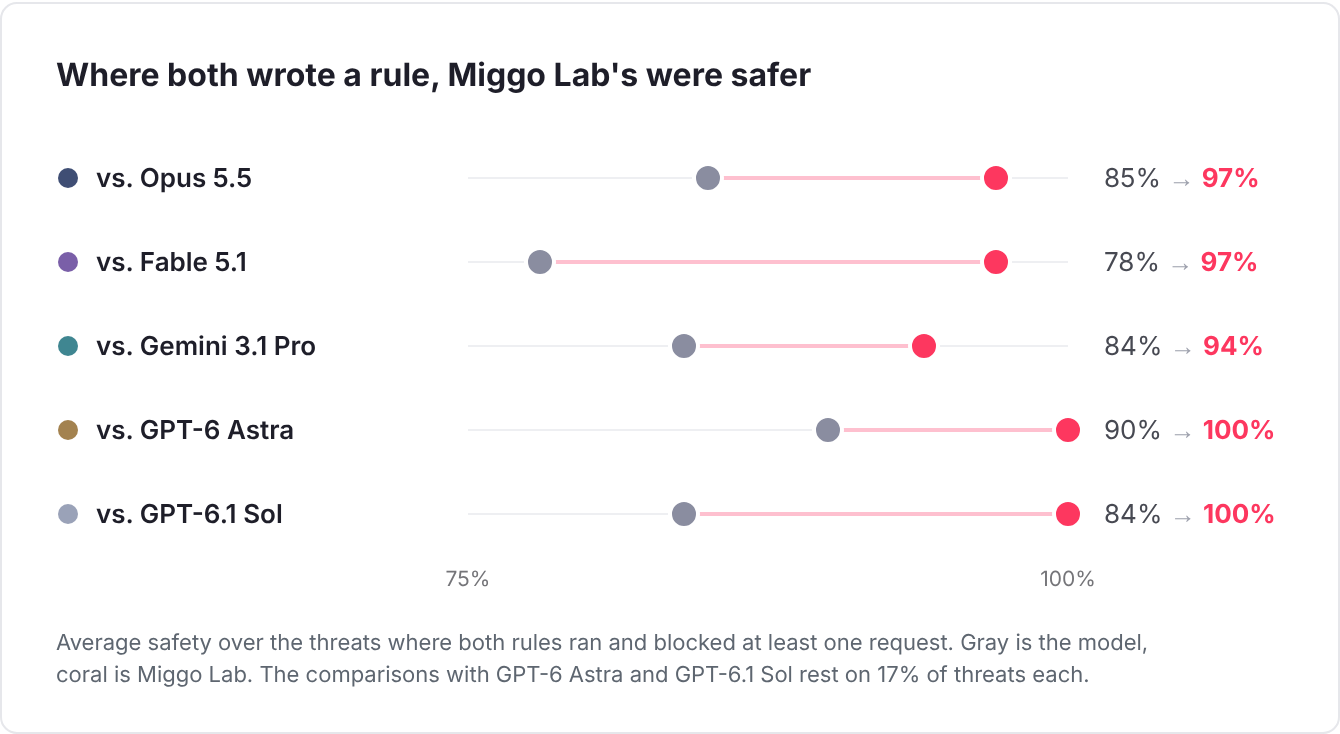
Measured as safety, the share of what a rule blocks that is a real attack, Miggo Lab's rules averaged 96%, against 90% for GPT-6 Astra, 85% for Opus 5.5, 84% for Gemini 3.1 Pro and GPT-6.1 Sol, and 78% for Fable 5.1. The GPT-6 Astra and GPT-6.1 Sol figures rest on only 17% of threats.
Where both approaches wrote a rule, Miggo Lab's were safer against every model: 97% against 85% for Opus 5.5, 97% against 78% for Fable 5.1 and 94% against 84% for Gemini 3.1 Pro.
Proven in Your Environment Before It Blocks
This benchmark scores rules on lab traffic. Production is different: an allowlist that runs first, a framework option nobody documented, traffic no lab could predict. So no Miggo mitigation enforces on day one. It runs in log mode on the customer's own traffic and is enforced only once it stops the exploit without touching legitimate requests, within the policy each team sets. When production disagrees with the Lab, in either direction, the result goes back to the Lab. In production, a Miggo mitigation never goes straight to Block:
- It deploys in log mode first, recording what it would have blocked without blocking anything.
- It is promoted to Block only after it has run against the customer's real traffic without matching a legitimate request.
- Promotion to block is based on the number of requests and/ or time. This is determined by the organization's policy and preference for autonomy vs human in the loop for promotion.
This additional validation tests mitigations against the customer's actual traffic before blocking begins, reducing the risk of disrupting legitimate application behavior.
On the held-out corpus, the Lab's rules blocked zero legitimate requests on 63% of threats, against 42% for Opus 5.5.

3. Half the WAF capacity: Miggo Lab used 49% less per rule than the leading model
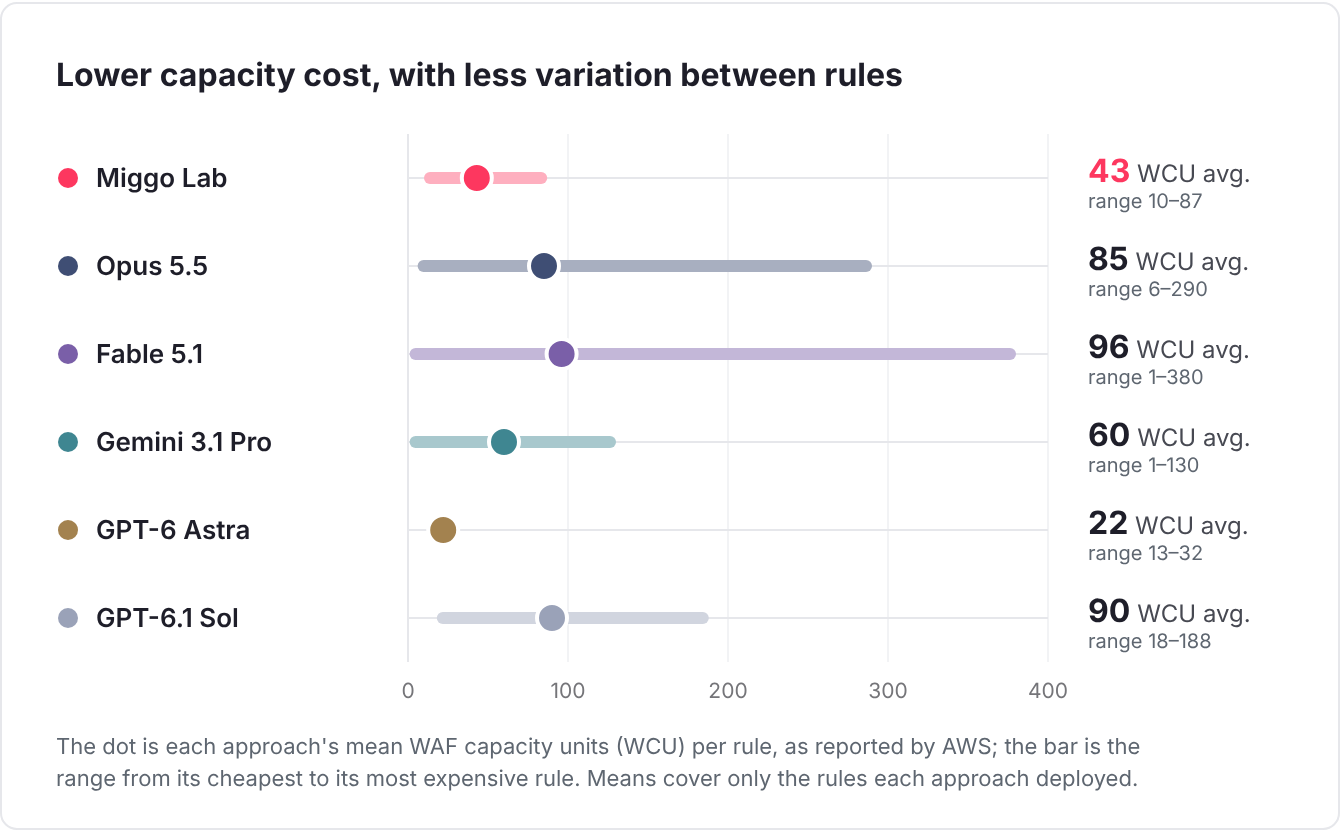
Miggo Lab's rules used 49% less WAF capacity on average than those of Opus 5.5, 55% less than Fable 5.1 and 28% less than Gemini 3.1 Pro. In practice, a Web ACL can hold nearly twice as many average Miggo Lab rules as average Opus 5.5 rules. GPT-6 Astra's rules used less capacity still, but it deployed rules for only 17% of threats.
Miggo Lab's capacity cost also varied less from rule to rule. The standard deviation of its WCU was 65% lower than that of Opus 5.5 and 72% lower than that of Fable 5.1, and its highest-WCU rule used 70% less capacity than the highest-WCU rule from Opus 5.5.
4. Models Produced No Deployable Rule on 46% of Attempts. Miggo Mitigation Lab Covered 100%
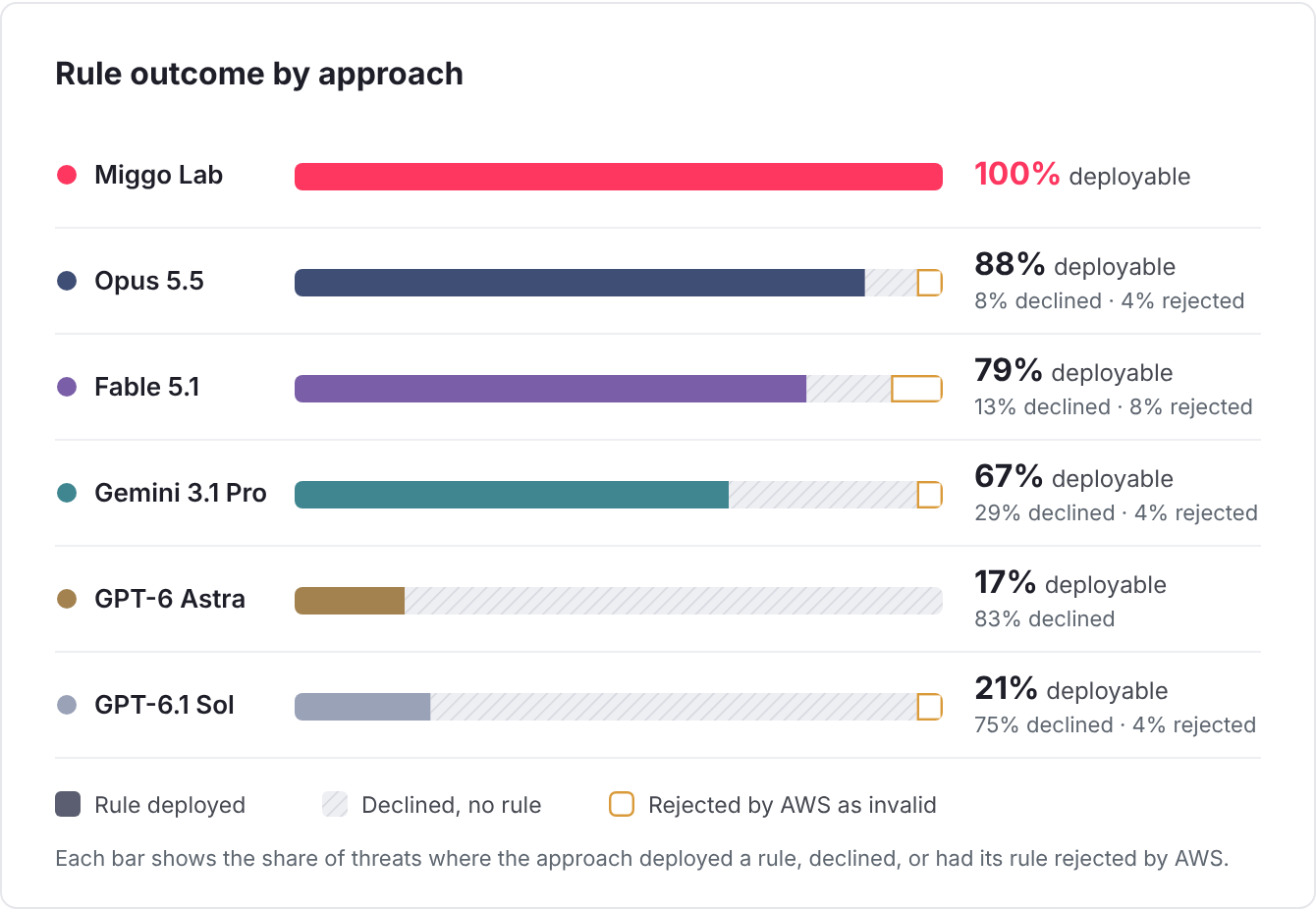
The first challenge wasn't stopping the exploit. It was producing a mitigation that could be deployed at all. Across all tasks, the frontier models judged a threat not blockable at the WAF 42% of the time, and AWS rejected another 4% of their rules as invalid. That left 46% of tasks with no protection. GPT-6 Astra declined on 83% of threats and GPT-6.1 Sol on 75%. Miggo Lab delivered a deployable mitigation for every threat.
In most cases, the model explained that it could not block the exploit without also blocking legitimate traffic (see Appendix B). That is a fair concern for a model working from a single prompt. Miggo Lab answers it with evidence: it builds lookalike traffic and tests against it until the rule separates the two.
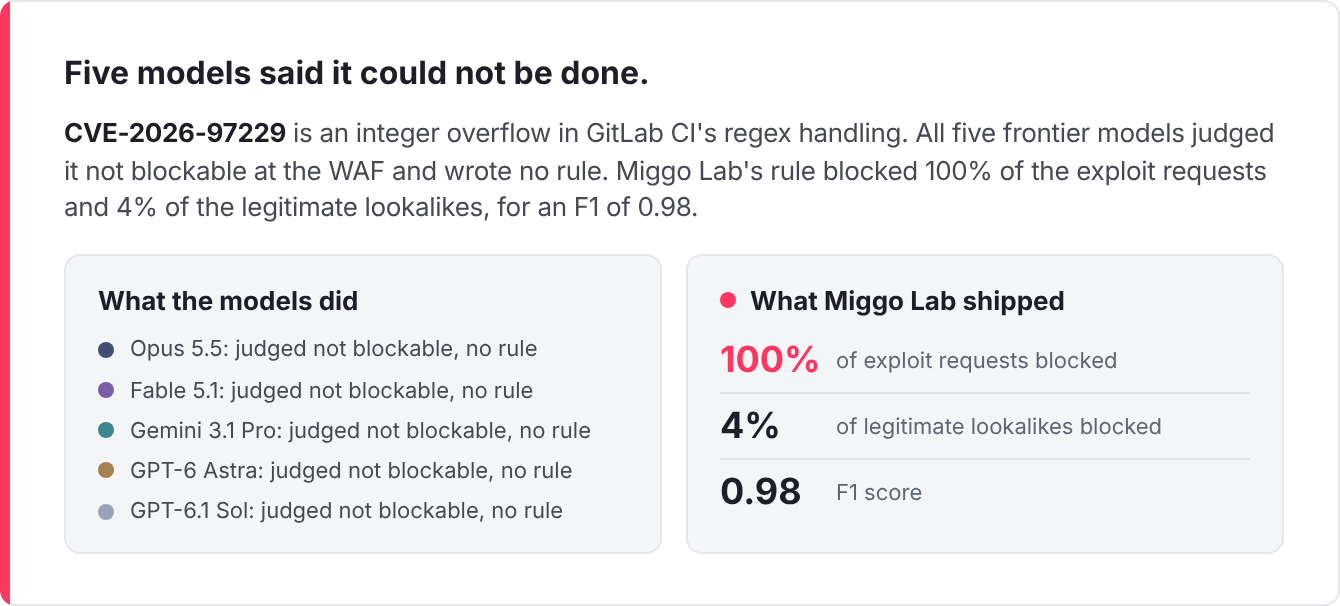
Five models said it could not be done. CVE-2026-97229 is an integer overflow in GitLab CI's regex handling. All five frontier models judged it not blockable at the WAF and wrote no rule. Miggo Lab's rule blocked 100% of the exploit requests and 4% of the legitimate lookalikes, for an F1 of 0.98.
5. Head to Head: Miggo Lab Matched or Beat Opus 5.5 on 79% of Threats
Efficacy and safety pull against each other. Widening a rule raises efficacy and lowers safety, and narrowing it does the reverse. The skill lies in finding the rule that holds both. F1 combines the two and rewards a rule only when it holds both.
Totals can hide a lot, so we also set Miggo Lab against each model one threat at a time, comparing F1. Against Opus 5.5, Miggo Lab scored higher on 58% of threats, tied on 21% and scored lower on 21%. Against every other model, it scored higher on at least 79% of threats. Across all approaches, Miggo Lab had the best or tied-best F1 on 75% of threats.

Opus 5.5 scored higher on 21% of threats. We report those cases because a benchmark that never shows a loss is hard to trust, and because they show where the Lab's work continues.
6. What Miggo Lab Does That a Prompt Cannot
A frontier model writing a mitigation works from what it knows about the CVE. Miggo Lab confirms the vulnerability is exploitable, then researches it as both attacker and defender, testing each candidate against exploit variants and lookalike traffic until a rule holds.
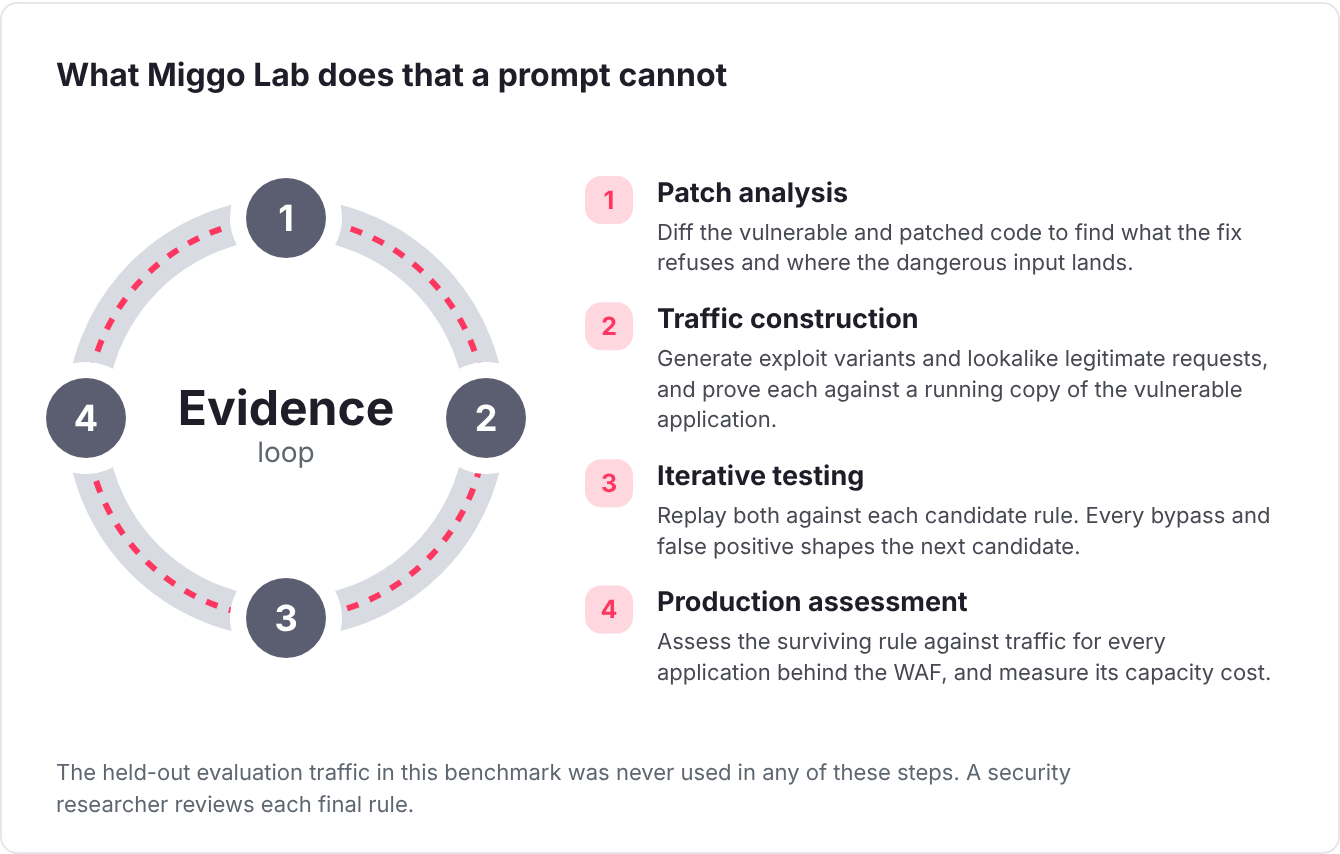
The same workflow produces mitigations enforced by the Miggo sensor inside the application for vulnerabilities that cannot be addressed at the WAF layer. Those were outside the scope of this study.
Why This Matters: Mitigate Now, Patch When You're Ready
Patching remains the root-cause fix, but it takes weeks or months, and attackers no longer wait that long. Mitigation closes the exploit path in the meantime. For that to work at scale, mitigations must arrive quickly and be trusted enough to deploy without a debate every time. Frontier models have solved the first problem. This benchmark shows that the second takes a process: evidence about the specific vulnerability, real traffic to test against, a measured standard for what counts as safe, and a rollout that proves the mitigation before it blocks anything.
Even the best result here let 128 of 969 exploit requests through. The Lab earns a rule its shot at production. Your traffic earns it Block. As described in our Autonomous Mitigation white paper, customers choose the level of autonomy with which they are comfortable, from reviewing every mitigation to letting validated mitigations deploy on their own.
Methodology
Which Threats We Tested
Miggo processes vulnerability records and updates from NVD, the GitHub Advisory Database and other public advisories. During the study window, it processed approximately 40,000 records. From these, Miggo identifies High Emerging Threats (HETs), which require evidence of exploitation in the wild or a working public exploit validated in Miggo Lab, plus a viable path to exploitation based on attack vector, authentication requirements and prerequisites.
The benchmark covers vulnerabilities that can be mitigated at the HTTP layer. Most are HETs that Miggo Lab worked on during the study period. A few are not HETs from that period: they are vulnerabilities Miggo Lab found in customer environments and judged important enough to write a rule for. Together they span AI application platforms, developer and collaboration tools, e-commerce and content management systems, and widely used frameworks and middleware. Because the Lab had already worked on each one, its 100% coverage is not a success rate across all vulnerabilities.
How the Traffic Was Built
For each threat, we started from documented exploits and public proofs of concept, then generated variants using frontier models and Miggo's own exploit-variant generation. Every candidate was run against a live copy of the vulnerable application, and only requests that reached the documented impact were kept. We also built legitimate requests aimed at the same endpoints and parameters and made to resemble the attacks; each had to complete successfully without triggering the exploit.
A separate traffic generator built this evaluation corpus, and it was never used to build, select or tune any mitigation, so every score reflects previously unseen requests.
How Each Mitigation Was Produced
Each model received the same prompt, changing only the CVE identifier. It asked for one self-contained AWS WAFv2 rule in Block mode and allowed the model to decline if it judged the threat not blockable at the WAF. The prompt emphasized that the rule has to block exploitation attempts without disrupting legitimate traffic. Each model was queried once per threat, with no access to the application, no feedback and no retries, and no output was edited or selected from multiple candidates.
Miggo Lab produced its rules through its standard workflow (Section 6). A security researcher reviewed each final rule before it entered the benchmark, without changing it.
How Mitigations Were Tested and Scored
Each rule ran as the only rule in a dedicated AWS WAF Web ACL. We replayed every request through it and recorded the WAF's verdict (Block or Allow). Rules that AWS rejected as invalid were not replayed.
Scoring Definitions At-a-Glance
- Efficacy (Recall): the share of a threat's exploit requests the rule blocked, averaged over all threats. A declined or rejected rule counts as 0%.
- Safety (Precision): the share of the rule's blocks that were exploit requests, averaged over the threats where the rule ran and blocked at least one request. A threat with no rule is left out rather than counted as perfectly safe, which would reward declining.
- F1: the harmonic mean of efficacy and safety for each threat, averaged over all threats. A declined or rejected rule counts as 0.
- Rule coverage: the share of threats for which the approach produced a rule AWS accepted and deployed.
- Control cost: the mean WAF capacity units (WCU) AWS reports for the approach's deployed rules.
Safety and efficacy correspond to the statistical measures precision and recall. We use these names because they are more intuitive for security teams.
Limits of this Study
- System-level comparison. The benchmark compares an evidence-driven system with tools, iteration and researcher review against a single model response. It does not measure which underlying model is smarter.
- Threat selection. The threats come from Miggo Lab's own recent work, not a random sample, so the results show comparative performance on these threats, not a success rate across all HETs.
- Traffic. Legitimate traffic was built to resemble the attacks. That tests safety hard but does not mirror production traffic.
- Enforcement. Only AWS WAF was tested, and capacity figures are specific to AWS.
- Model conditions: Two OpenAI models run under cyber safeguards that may route requests to a fallback model; versions were current as of November 1.
- Corpus overlap: the evaluation and development corpora were built by separate components that share Miggo's exploit-generation approach.
What Comes Next
We will expand this evaluation to more HETs, more models and more controls, and publish the results each time. Security teams that want Miggo's Mitigation Lab to run against a vulnerability of their choosing can request it here.
Appendix A: Frequently Asked Questions
Did you choose threats that favor Miggo Lab?
The threats come from Miggo Lab's recent work, so the Lab had worked on each one before. We removed nothing after seeing the results, and Section 5 shows where a model scored higher. All approaches were scored on the same held-out traffic, which was never used to build the mitigations.
Why does a declined threat count as zero?
A threat without a mitigation is a threat without protection, so it scores zero for efficacy and F1. It is left out of the safety average, because counting it as perfectly safe would reward declining.
Why only AWS WAF?
AWS WAF gave us one consistent environment in which to replay every request against every rule and record a real verdict. We plan to extend the benchmark to other enforcement environments.
Will you publish the full data set?
This report summarizes the results. Security teams that want to review the methodology or the data in more depth can contact us here.
Appendix B: Representative Model Refusals
CVE-2026-9198 - GPT-6.1 Sol
I cannot provide a self-contained AWS WAF rule that reliably blocks CVE-2026-9198 while preserving legitimate functionality.
The exploit chains /api/v1/auto_login, which issues a superuser token, with /api/v1/validate/code, which executes submitted Python. The attacker therefore reaches code validation with a valid token; requiring an authorization header would not prevent exploitation.
My assessment is that WAF cannot reliably distinguish this abuse from legitimate use: automatic superuser login is part of Langflow’s documented editor behavior, and Python submission serves code validation. Blocking either endpoint would disable its legitimate functionality. Matching selected Python keywords would provide incomplete protection because equivalent payloads can use different syntax.
Consequently, I am not generating a rule. Upgrade to Langflow 1.10.1 or a later patched release, as IBM recommends. Also disable automatic login and require authentication through an authenticating reverse proxy, following Langflow’s deployment guidance.
Miggo’s take
While this CVE is indeed challenging to protect in the WAF layer, Miggo took an approach that tracks patterns used by attackers to reach RCE. Miggo also scanned the internet in order to validate that the patterns in the rule are not found in legitimate code. The Miggo Lab rule for this CVE reached 67% efficacy while maintaining 100% safety. The bottom line - Miggo was able to find a reasonable tradeoff between efficacy and safety, while GPT-6.1 Sol always decided to go for one of the extremes.
Second chance - we gave GPT-6.1 Sol a more permissive prompt, that does not mention the false positive risk at all
GPT-6.1 Sol generated an aggressive rule that blocked all calls to the /api/v1/auto_login and validate/code routes. The rule blocked all of the benign requests in the set.
CVE-2026-122006 - Gemini 3.1 Pro
Unfortunately, CVE-2026-122006 cannot be reliably and effectively blocked at the WAF layer without risking massive false positives or leaving trivial bypasses. Because of this, I will not generate an AWS WAF rule, as it would give a false sense of security while potentially blocking legitimate business traffic.
Here is why a WAF is the wrong tool to mitigate this specific vulnerability:
1. AWS WAF Request Body Inspection Limits
CVE-2026-122006 is an arbitrary file read/write vulnerability in Ruby on Rails' Active Storage component, triggered when ImageMagick processes a maliciously crafted uploaded file (such as Magick Scripting Language - MSL). File uploads are typically transmitted via multipart/form-data request bodies. AWS WAF has a strict limitation on body inspection: it can only inspect up to the first 8 KB (or 64 KB if explicitly configured and paid for) of the request body. An attacker can trivially bypass any WAF rule by padding the uploaded file with 65 KB of harmless image data or junk bytes. The malicious MSL or Ghostscript payload would fall outside the inspected range, passing right through the WAF while still executing successfully on your server.
2. Polyglots and File Format Obfuscation
ImageMagick determines file types based on content heuristics and magic bytes, not just file extensions or Content-Type headers. An attacker can easily spoof a legitimate Content-Type: image/jpeg header and use a polyglot payload (a file that is valid in multiple formats). If a WAF tries to block .msl extensions or suspicious content types, the attacker will just send the payload disguised as a standard .jpg or .png.
3. Extremely High Risk of False Positives
MSL (Magick Scripting Language) is an XML-based format. To catch it in a WAF, you would have to write rules matching XML tags like <image>, <read>, or <write> inside request bodies. Doing this on file uploads will trigger massive false positives, blocking legitimate SVG images, standard XML documents, and SOAP requests, which directly conflicts with your requirement not to drop legitimate business traffic.
How you should mitigate this instead:
To protect your application, you must apply mitigations at the application or OS level:
1. Patch: Upgrade the activestorage gem to the patched versions (8.0.5.2 or 8.1.4.1).
2. System Workaround: If you cannot patch immediately, implement the official Rails workaround by editing ImageMagick's system policy.xml to explicitly disable the vulnerable coders. Add the following policies to deny MSL and Ghostscript processors:
<policy domain="coder" rights="none" pattern="MSL" />
<policy domain="coder" rights="none" pattern="PS" />
<policy domain="coder" rights="none" pattern="EPI" />
<policy domain="coder" rights="none" pattern="PDF" />
<policy domain="coder" rights="none" pattern="XPS" />
Miggo’s take
Although the body inspection limit presents a significant challenge, it is still feasible to establish a "best effort" rule that safeguards against common exploits. Most proof-of-concept (POC) implementations available on the internet adhere to this limit and do not transmit images that exceed it. Miggo's best effort rule achieved 92% efficacy and ensured 100% safety.
Second chance - we gave Gemini 3.1 Pro a more permissive prompt, that does not mention the false positive risk at all
Gemini 3.1 Pro generated a rule that blocked no exploits. The rule requires the exploit to arrive on Rails' built-in Active Storage endpoints, but most apps receive uploads through their own routes, so most attacks never reach the place the rule watches. The rule also looks only for MSL, MVG and SVG markers. It misses the most common way this vulnerability is exploited, Ghostscript-based PostScript, EPS and PDF files, so it gives almost no real protection.
CVE-2026-60004 - GPT-6 Astra
I cannot provide a WAF rule that reliably blocks CVE-2026-60004 while preserving legitimate traffic.
This Gitea vulnerability involves applying patches in a bare temporary repository. Repeated patch submissions can trigger Git’s conflict handling and turn repository content such as hooks/post-index-change into an executable hook. Exploitation depends on server-side repository state, which a WAF request signature cannot evaluate.
Blocking the diffpatch endpoint would interrupt legitimate patch operations. Matching hook filenames or shell commands could also block legitimate source content without providing complete protection. Body inspection adds another limitation: AWS WAF inspects only a bounded portion of requests; blocking all oversized patches would reject legitimate traffic, while permitting them leaves uninspected content.
Under your requirements, I’m therefore not generating a rule. Upgrade Gitea to a supported release containing the fix introduced in 1.27.1.
Miggo’s take
Miggo’s rule was focused on catching non-standard hook files input to the _diffpatch route. While a lot of legitimate traffic goes through _diffpatch, only special hooks trigger the vulnerability. These hooks are rarely changed and are visible in the request format. Such input is rare in a non-malicious request, and in this case, the non-essential feature will be disrupted. Miggo’s rule reached 99% efficacy and 95% safety.
Second chance - we gave GPT-6 Astra a more permissive prompt, that does not mention the false positive risk at all
GPT-6 Astra generated a rule that blocks every POST request to Gitea’s API endpoint /api/v1/repos/{owner}/{repo}/diffpatch and looks at nothing else. This rule reached 70% efficacy and 83% safety.