Hot off the press. Today we're releasing Prompted vs. Proven: Five Frontier Models Against Miggo's Mitigation Lab, a new Miggo research report that puts Miggo's Mitigation Lab (Miggo Lab) head to head with five leading frontier AI models: Opus 5.5, Fable 5.1, Gemini 3.1 Pro, GPT-6 Astra and GPT-6.1 Sol.
The question we set out to answer is the one every security team is asking right now: when a new CVE lands, can a frontier model give you a mitigation you would actually ship? We ran every rule in AWS WAF against 1,757 replayed requests and let the WAF's verdict do the scoring.
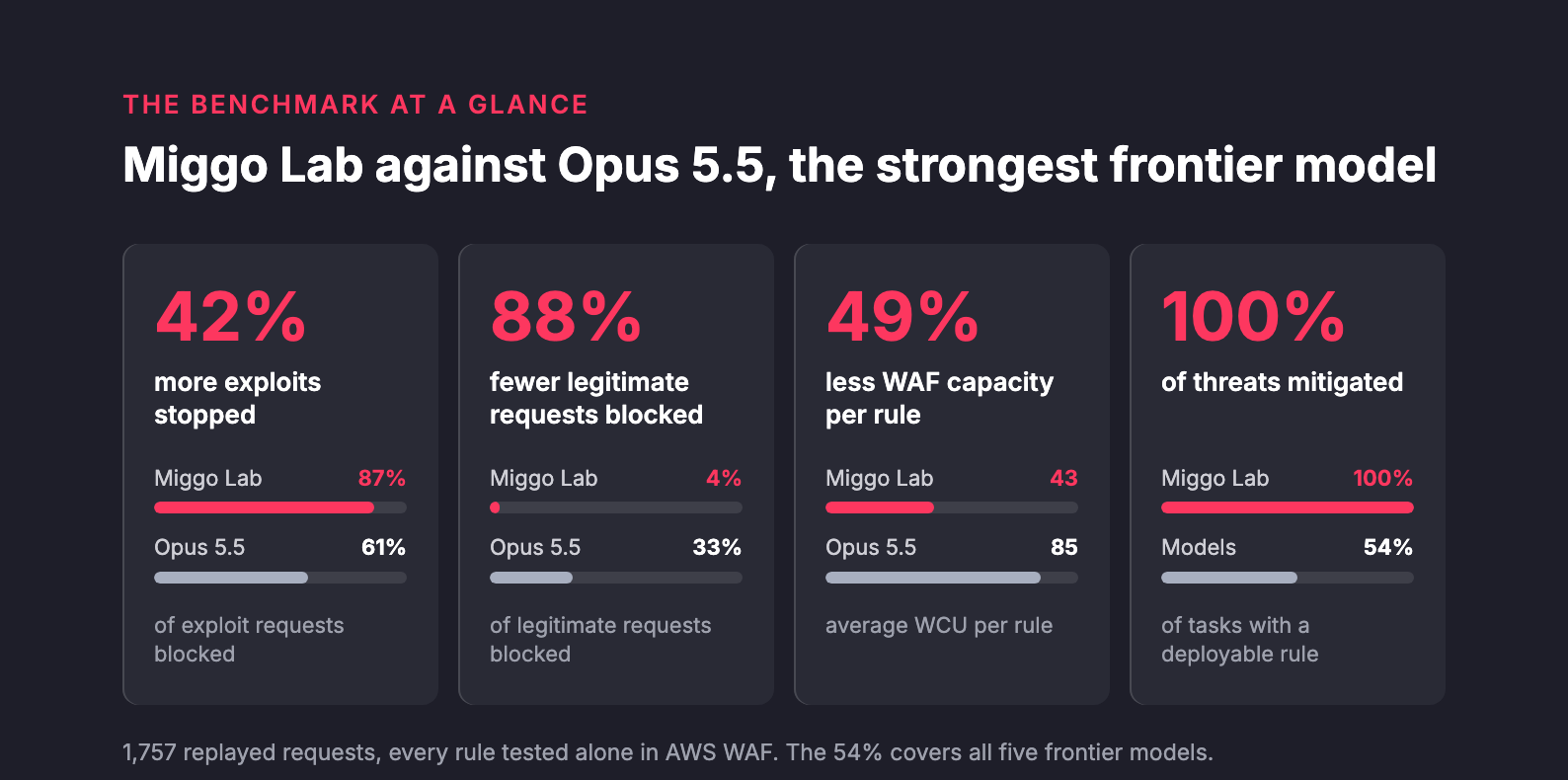
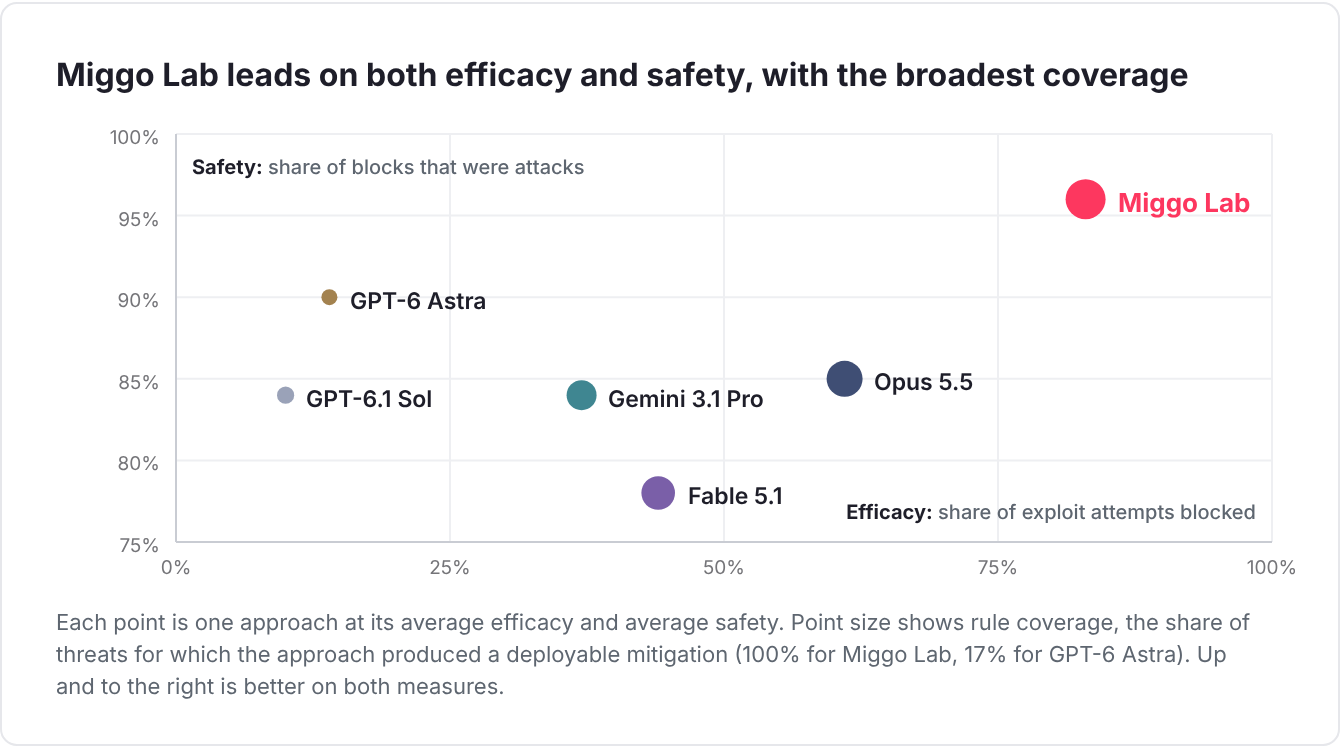
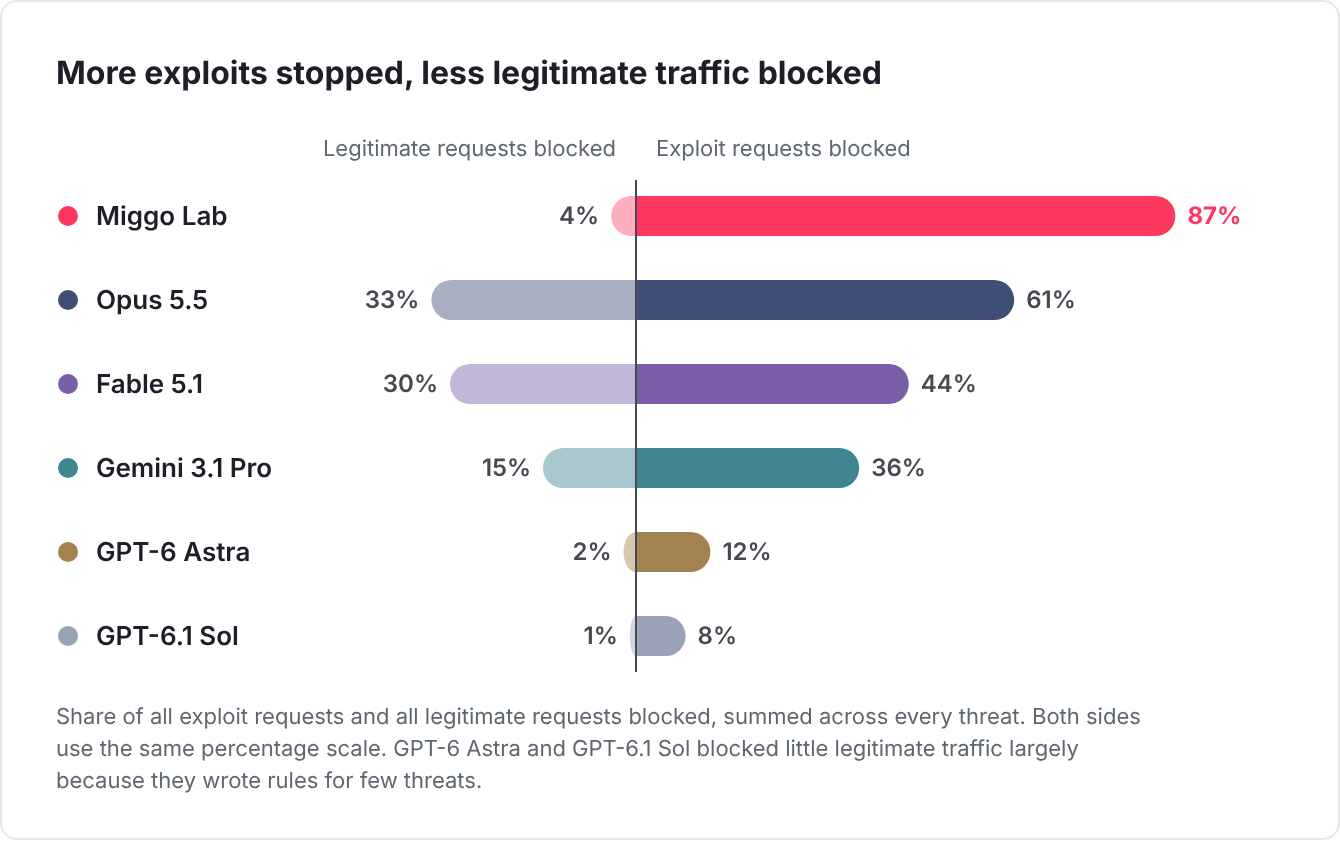
The short answer: Miggo Lab blocked 42% more exploits and was the safest, with the least false positives: 96% of its blocks were real attacks, 11 points above Opus 5.5, and it blocked 88% fewer legitimate requests. It also used half the WAF capacity of the strongest model and delivered a deployable mitigation for every threat in the set.
See the full report: Prompted vs. Proven: Five Frontier Models Against Miggo's Mitigation Lab
Why We Ran It
The time between disclosure and exploitation keeps shrinking. Frontier AI models made attackers faster, and a team that waits for the patch is just exposed.
The same models offer defenders a shortcut. Paste a CVE into any of them and a proposed WAF rule comes back in seconds. But a generated rule is only a hypothesis until it has been tested, and a mitigation has to pass three tests before a security team can trust it:
- Effective: It blocks the exploit, including the variants an attacker tries once the first payload fails.
- Safe (least false positives): It leaves legitimate traffic alone. A rule that breaks the application gets rolled back, and the team is exposed again.
- Efficient: It fits the budget. WAF capacity is finite, and an expensive rule crowds out the next one.
How We Tested
The threats were recent vulnerabilities that can be mitigated at the WAF layer, most of them High Emerging Threats (HETs). Each mitigation ran alone in its own AWS WAF Web ACL against 1,757 requests: 969 validated exploits and 788 legitimate requests built to look like them. Every score comes from the WAF's recorded verdict, never from reading the rule.
What We Found
Against Opus 5.5, the strongest model in the test, Miggo Lab led on every measure:
- Most effective: Miggo Lab blocked 87% of all exploit requests, 42% more than Opus 5.5, the strongest model.
- Safest (least false positives): 96% of Miggo Lab blocks were real attacks, 11 points above Opus 5.5, and the Lab blocked 88% fewer legitimate requests.
- Half the WAF capacity: 43 WCU per rule against 85 for Opus 5.5, so the same Web ACL holds about twice as many rules.
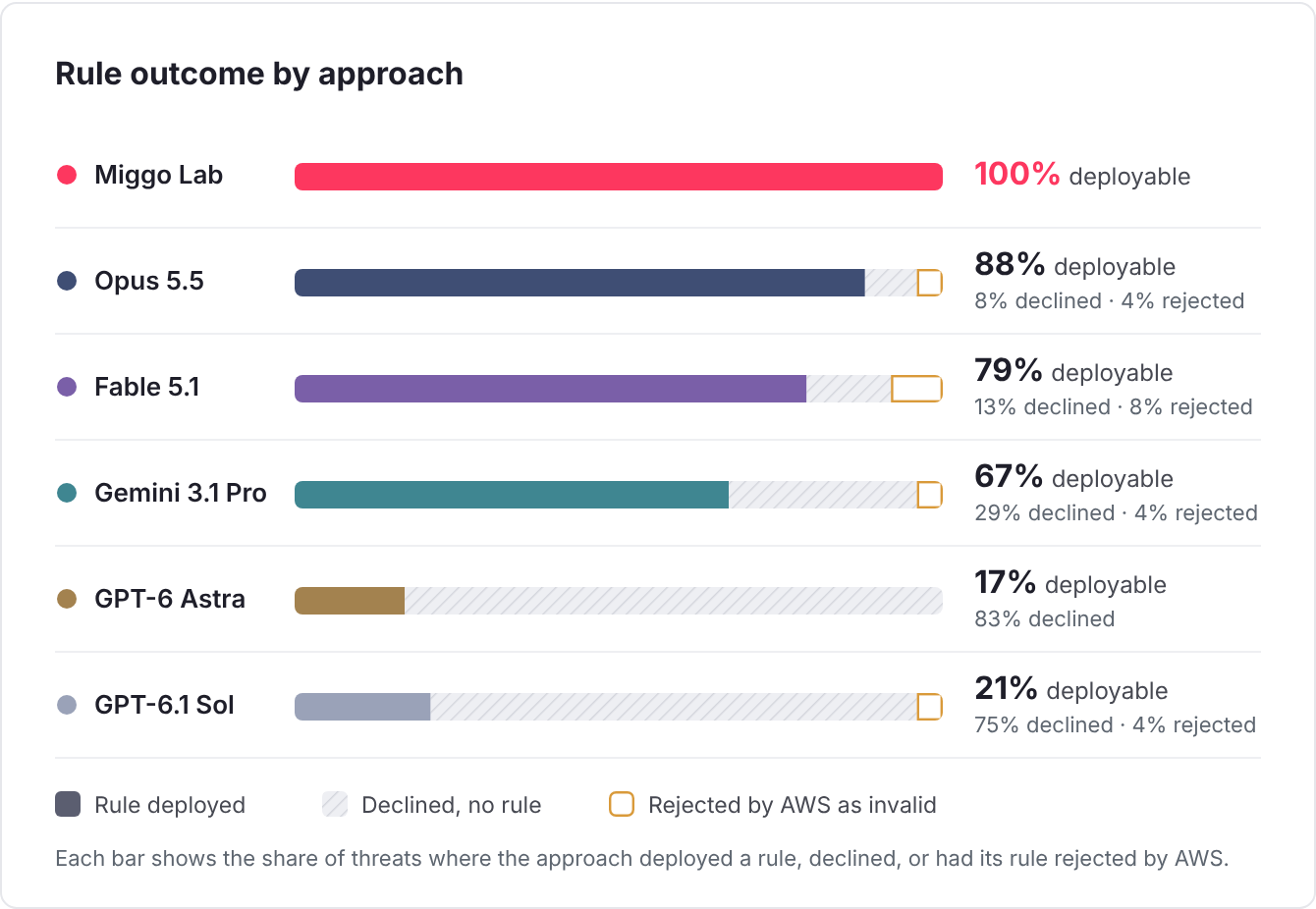
- Mitigation Lab provided 100% coverage of every vulnerability: the five models delivered one on 54% of their attempts, and none wrote a rule for CVE-2026-97229, a CVSS 10.0 GitLab RCE the Lab blocked on every exploit request.
Most of the models' failures happened before a single request was replayed. They declined the threat as "not blockable at the WAF," or AWS rejected their rule as invalid.
Five Models Said It Could Not Be Done
CVE-2026-97229 is a CVSS 10.0 remote code execution flaw in GitLab, triggered by an integer overflow in GitLab CI's regex handling. All five frontier models judged it not blockable at the WAF and wrote no rule. Miggo Lab's rule blocked 100% of the exploit requests and only 4% of the legitimate lookalikes (false positives), for an F1 score of 0.98.
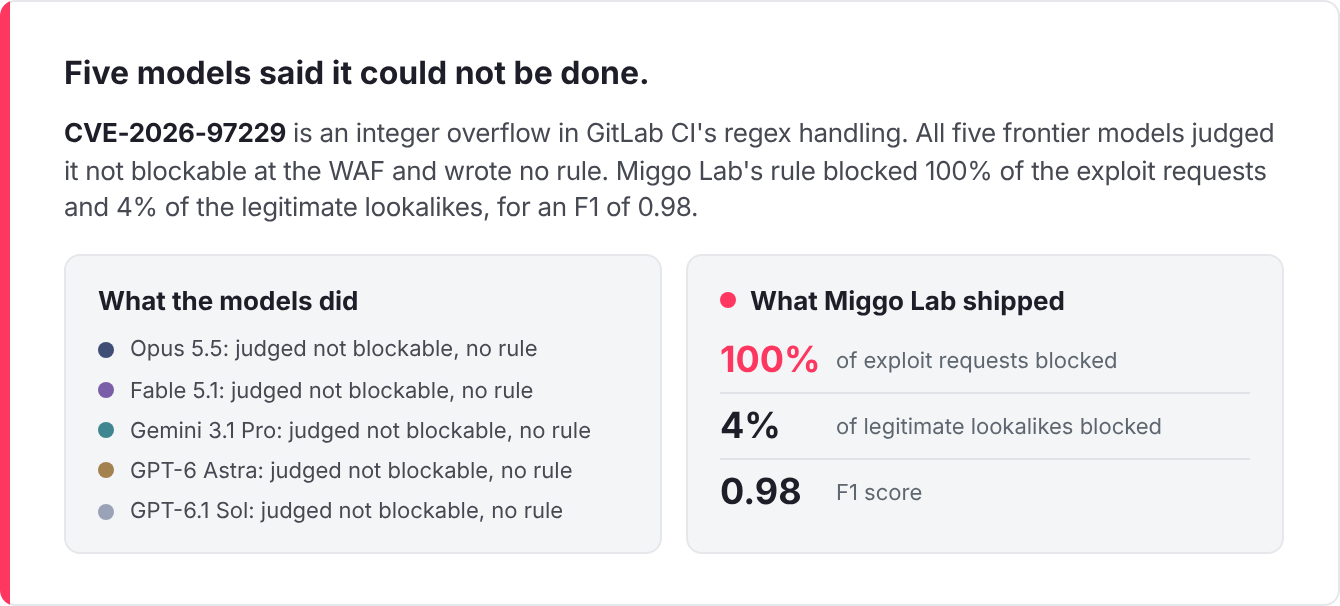
The models' reasoning was not careless. Most explained that they could not block the exploit without also blocking legitimate traffic, creating false positives. That is a fair concern for a model working from a single prompt. Miggo Lab answers it with evidence: it builds lookalike traffic and tests against it until the rule separates the two.
The Difference Isn't a Smarter AI Model, It's a Smarter AI Process
A frontier model writing a mitigation works from what it knows about the CVE. Miggo Lab treats every vulnerability as a research problem:
- Patch analysis. Compare the vulnerable code with the patched code to see exactly what the fix blocks and where the dangerous input enters the application.
- Traffic construction. Generate exploit variants and lookalike legitimate requests, and prove each against a running copy of the vulnerable application.
- Iterative testing. Replay both against each candidate rule. Every bypass and every false positive shapes the next candidate.
- Production assessment. Assess the surviving rule against traffic for every application behind the WAF, and measure its capacity cost.
The evaluation traffic in this benchmark was built separately and never used in any of these steps, so every score reflects requests the Lab had not seen.
Where the Lab Lost
Threat by threat, Miggo Lab matched or beat Opus 5.5 on 79% of threats and beat every other model on at least 79%. Opus 5.5 scored higher on 21%. We report those cases because a benchmark that never shows a loss is hard to trust, and because they show where the Lab's work continues.
Proven in Your Environment Before It Blocks
This benchmark scores rules on lab traffic. Production is different: an allowlist that runs first, a framework option nobody documented, traffic no lab could predict.
So no Miggo mitigation enforces on day one. It deploys in log mode on the customer's own traffic, recording what it would have blocked without blocking anything. It is promoted to Block only after it has run against real traffic without matching a legitimate request, by request volume, time or both, under the policy each team sets. Customers choose the level of autonomy they are comfortable with, from reviewing every mitigation to letting validated mitigations deploy on their own.
Mitigate Now, Patch When You're Ready
Patching remains the root-cause fix, but it takes weeks or months, and attackers no longer wait that long.
Every security team now has a frontier model that can draft a WAF rule in seconds. But a rule that misses leaves the application exposed, or a rule full of false positives gets rolled back, and the application is again exposed.
Miggo Lab removes that gamble by providing mitigations which are exploit-tested, checked against lookalike legitimate traffic and proven on your own traffic before it blocks anything. Your team gets protection the day a vulnerability lands, and patches on its own schedule.
See Prompted vs. Proven: Five Frontier Models Against Miggo's Mitigation Lab for the complete results, methodology, limits of the study and the model refusals in their own words.
Or even better, want to see it on your stack? Contact us and we'll show you what Miggo Lab stops.