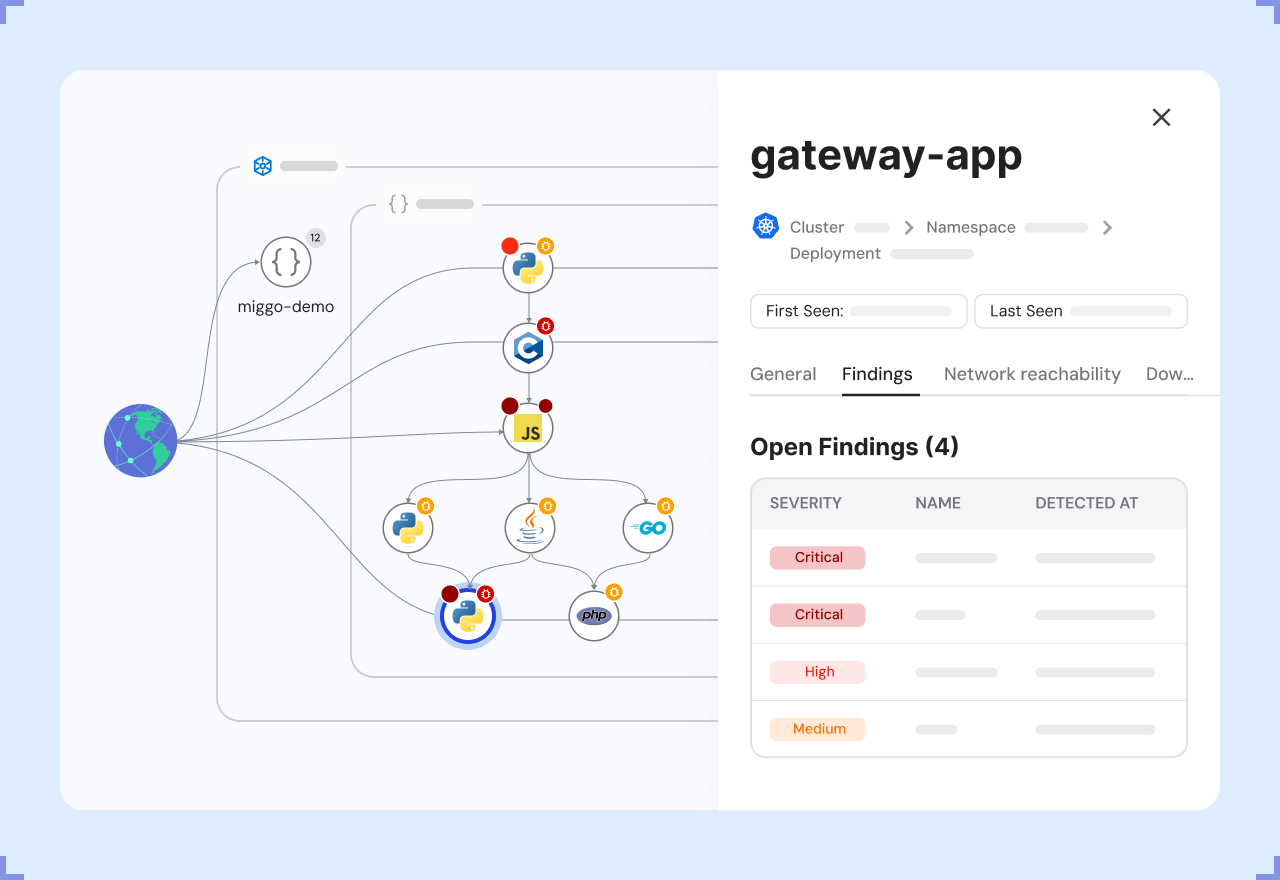






1. Know
Your next nine-figure breach is already a CVE.

Trusted by Industry Leaders
You Can't Patch a Core Banking System on a Tuesday
It Already Happened
services breach today
In Three Moves, Mitigate the Gap

2. Prove
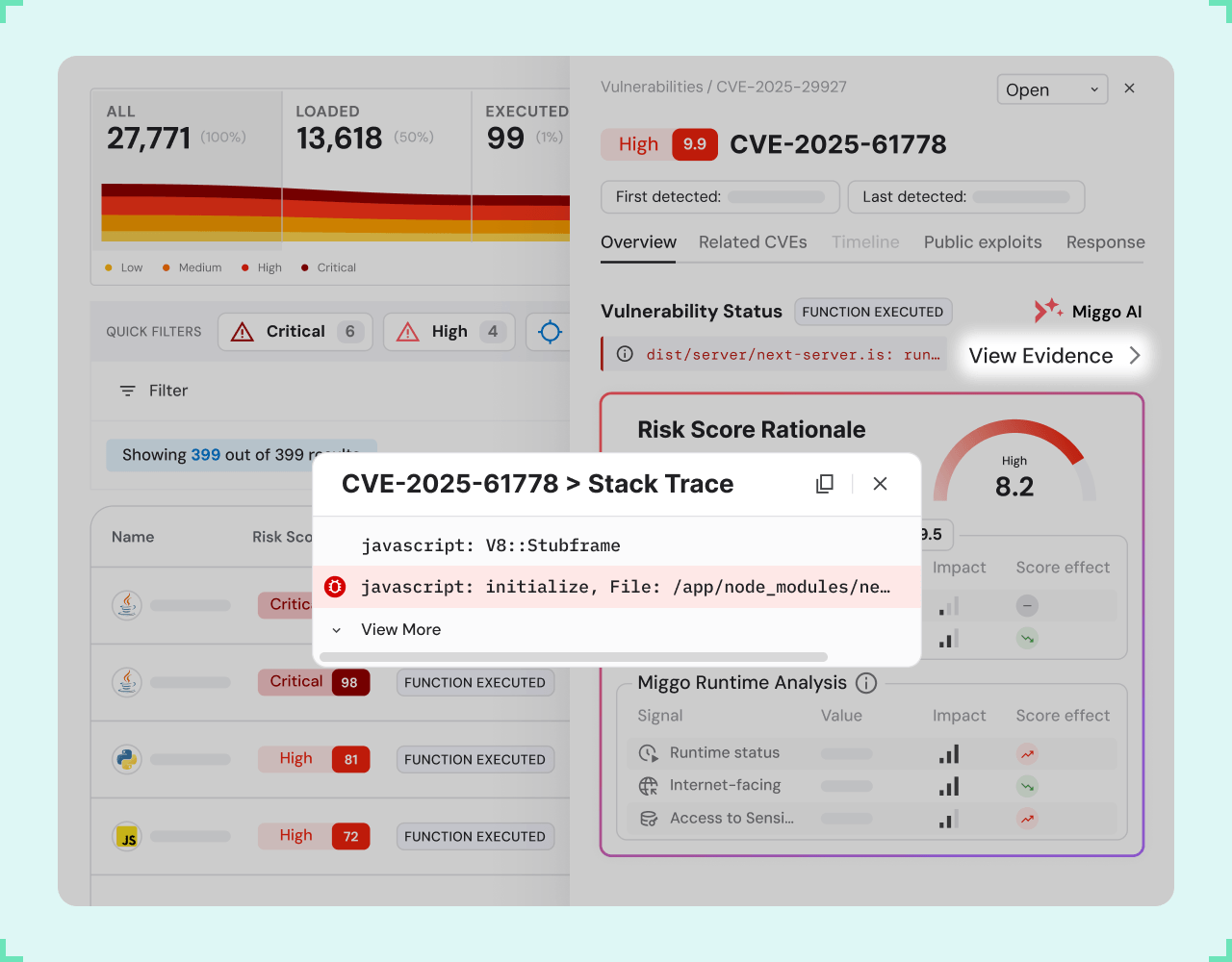
Prioritize what's actually exploitable

3. SHIELD
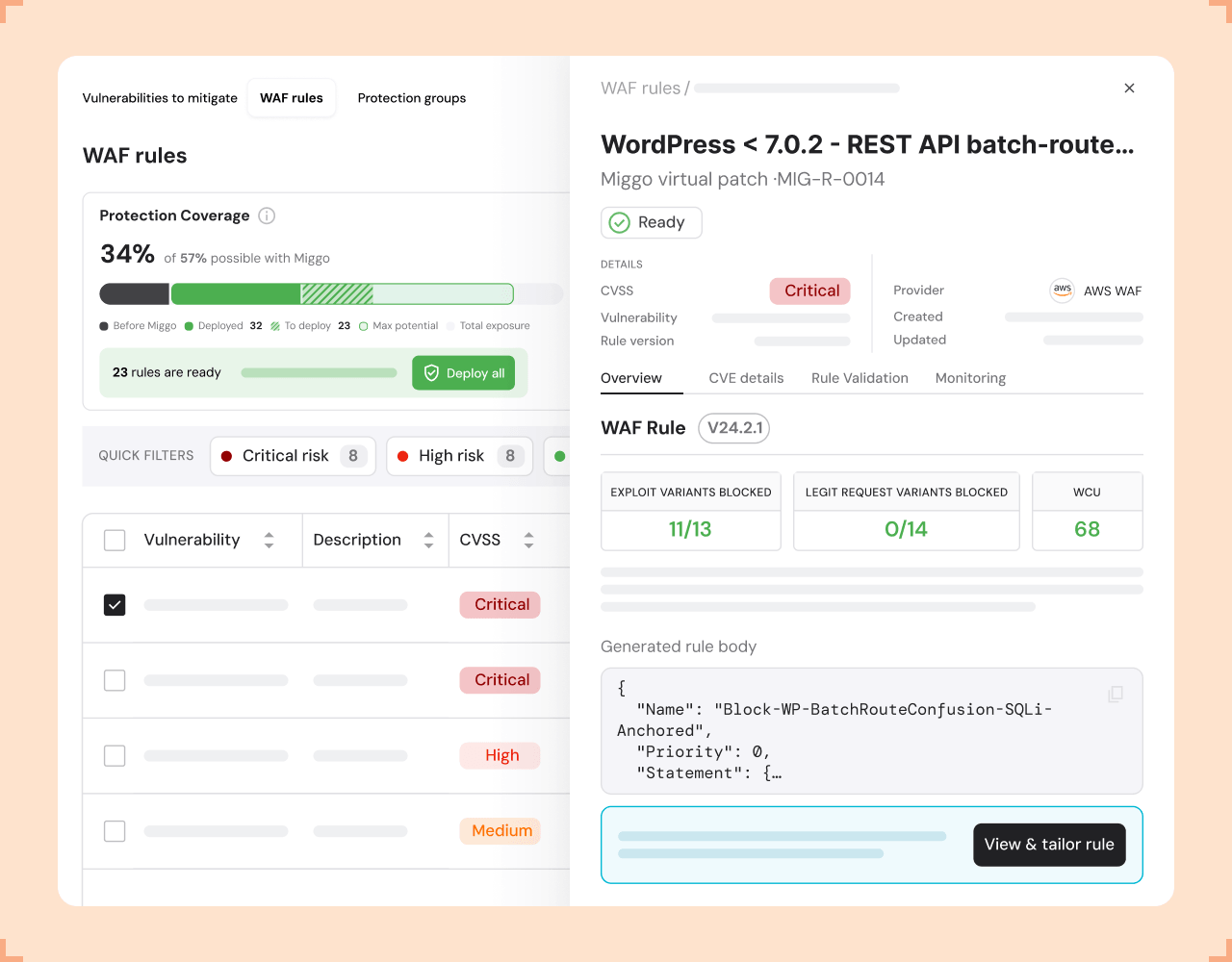
Shield instantly with virtual patching

Want to see this run against your own environment?
What customers get out of it
99%
50%+
<1hr
"Miggo's team felt like an extension of ours. In a moment of uncertainty, they jumped in, analysed live telemetry, and helped us rule out a potential threat in minutes."

Roye Jacobovich
VP R&D and CISO, Eitan Medical
Where Miggo Fits in Your Compliance Picture
See your gap. On us.
No credit card
No agent install
Results in minutes
Nothing to sign
Agentless eBPF-OTel sensor, deploys in under an hour
Frequently Asked Questions
Is Miggo an API security product?
No. Miggo is an Application Detection and Response (ADR) platform. It works at the application runtime layer, which includes the API calls your services make and receive, but it is not an API gateway and does not replace one. Its job is telling you which vulnerabilities in your running application are actually exploitable, and shielding them.
How is Miggo different from an ASPM or CNAPP tool?
ASPM and CNAPP tools assess posture and configuration, meaning what your environment looks like. Miggo works at runtime, meaning what your application actually does when a request arrives. That is the difference between knowing a vulnerable package is present and knowing whether the vulnerable code path can be reached in production.
What can we do about a CVE we can't patch?
Miggo virtual-patches it. It generates a precise WAF rule scoped to the specific exploitable path, deploys it to AWS WAF or Cloudflare in seconds, and expires it automatically when the real patch ships. The vulnerability stays open in the code; the exploit path closes at runtime.
How do you know which CVEs are actually exploitable in our production environment?
Miggo builds a live map of your running application, then tests each CVE in your backlog against real runtime reachability rather than against a package manifest. Across Miggo deployments, roughly 99% of a CVE backlog turns out to be unreachable in production.
If our board asks for our vulnerability landscape, can we answer quickly?
Yes. Miggo produces a live view of what is exploitable, what is shielded, and what is genuinely open, with the attack paths behind each. It cuts the time spent assembling audit evidence by hand by more than 50%.


.png)
.png)

.png)