Back to Reports and Webinars
Whitepaper

Autonomous Mitigation
Closing the Exploitability Window

What it is, why security needs it, and the standard for doing it safely.
Access Report
By submitting this form you agree to the processing of your personal data as described in our Terms and our Privacy policy.
Download PDF
Oops! Something went wrong while submitting the form.

In this Document

Frontier AI led to the rise of autonomous attackers, which are not only faster but have a greater arsenal. A model can read a released patch, derive the underlying flaw, generate a working exploit, mutate it into a family of variants, scan targets and conduct reconnaissance, with no human in the loop and without the specialist skill that used to gate it all. This changed two things at once: an operational exploit for a vulnerability can arrive in hours instead of weeks; and the entire attack process, from reconnaissance to exploit mutation, can take place across every target at once.
Security teams have become highly efficient at discovering vulnerabilities, but they struggle with a fundamental bottleneck: the 'exploitability window' - the time between when a weakness can be exploited and when the system is actually protected. While permanent code changes or software patches (remediation) fix the flaw for good, they operate on engineering schedules which follow human tempo and often involve complex organizational workflows. At the same time, AI enables attackers to exploit weaknesses at machine speed.
Operating within strict policy guardrails and utilizing continuous testing and governance, Autonomous Mitigation closes the exploitability window instantly, keeping organizations secure while long-term fixes are prepared, without disrupting business operations.
The Problem:

Finding the Risk Is Not the Same as Reducing It

Defenders have never been better at finding risk. Frontier AI models now uncover flaws that years of expert review missed, and we scan more assets, test more applications, and surface more findings than ever. But a finding does not change the security state. A vulnerability stays usable by an attacker until something actually stops the exploit path from succeeding.
That leaves the mismatch that defines the modern program: risk is discovered at machine speed but remediated at human speed, through tickets, engineering queues, testing cycles, release windows, and patch schedule
Organizations need both tactics to manage their vulnerability exposure. Remediation eliminates the flaw; mitigation eliminates the attacker's exploit window while remediation proceeds.

The two clocks of taking action

Vulnerability management programs lay out two options to respond once a vulnerability has been discovered, analyzed, and prioritized: remediation and mitigation. While typically viewed as parallel actions, remediation and mitigation actually run on two separate clocks:

Remediation: The Slow Clock.

Remediation removes the root cause through a patch, dependency upgrade,code change, or config correction. The fix to the vulnerability is permanent,but the response is slow, as even in the age of AI driven code remediation,it’s bound to engineering workflows, regression testing, multiple ownerswithin an organization, change management, and business schedule thatdoesn’t always allow code changes.

Mitigation: The Fast Clock.

Mitigation changes the current security state so the exploit path can no longersucceed, without necessarily removing the underlying flaw or fixing thevulnerability root cause. It uses controls already in the environment, atwhatever layer the exploit has to cross: the network (WAFs, Firewalls, APIgateways), access policy, configuration, or the application runtime itself. Noneof these require code changes, so mitigation can be deployed without waitingon engineering cycles.

What Gartner analysts say

We call that interdiction action layer Autonomous Mitigation. It enforces protective controls wherever they sit, e.g., WAFs, gateways, runtime, network, but closing the window reliably requires one system to be accountable for the entire process: proving the exposure is exploitable, choosing and generating the protection, enforcing it, and sustaining it until remediation lands. That accountability layer is the category this paper defines.

"As attackers use advanced AI to find and exploit vulnerabilities faster than organizations can patch them, prioritizing exposures based solely on inferred risk is no longer enough. Product leaders must adopt preemptive exposure management, using AI-driven validation to prove evidence of exploitability and autonomous interdiction to neutralize attack paths, delivering measurable, real-time risk reduction."

Gartner®, Agentic Security: Preemptive Exposure Management Demands AI-Driven Validation and Autonomous Interdiction, Luis Castillo, Elizabeth Kim, Tom Powledge, Mitchell Schneider, Craig Lawson, 28 September 2026 GARTNER is a trademark of Gartner, Inc. and/or its affiliates.

We call that interdiction action layer Autonomous Mitigation. It enforces protective controls wherever they sit, e.g., WAFs, gateways, runtime, network, but closing the window reliably requires one system to be accountable for the entire process: proving the exposure is exploitable, choosing and generating the protection, enforcing it, and sustaining it until remediation lands. That accountability layer is the category this paper defines.

What the data says

Mandiant's M-Trends 2026 puts the mean time to exploit at minus seven days. In their words, "exploitation is routinely occurring before a patch is even released." In 2018 the same measure was 63 days.
CISA's Known Exploited Vulnerabilities catalog held 1,717 entries as of 21 September 2026, 233 of them added during 2026, with 360 linked to known ransomware campaigns. These are not theoretical exposures. They are vulnerabilities with confirmed exploitation in the wild, and the list grows faster than any release cadence can absorb.

The standards already endorse mitigation

In 2026 CISA issued Binding Operational Directive 26-04, which supersedes and revokes BOD 22-01. It requires federal agencies to remediate the highest risk vulnerabilities, meaning anything publicly exposed, automatable, granting total control, and known to be exploited within three calendar days.
Critically, it does not require that the fix be a patch.
This is consistent with the wider framework landscape. NIST SP 800-40r4 formally lists mitigation as a risk response and defines it to include "deploying additional security controls to reduce vulnerability exploitation" - not only patching. PCI DSS v4.0 discusses compensating controls where an organization has a legitimate and documented technical or business constraint preventing it from meeting a requirement as stated.
Case Study:

React2Shell (CVE-2025-55182)

React2Shell is an unauthenticated remote code execution flaw in React Server Components, in the React Flight protocol's multipart form-data handling, a prototype-chain traversal (parseModelString → reviveModel → getOutlinedModel) that reaches JavaScript's Function constructor and runs attacker code. CVSS 10.0.

Timeline:

Nov 29
Privately reported to Meta
Dec 3
Disclosed with patches

Attempted exploitation by China-Nexus threat groups reported

Dec 5
A public PoC landed and mass exploitation began
Dec 6-10
WAF bypasses for Cloudflare, AWS WAF, and Akamai were disclosed one after another.
React2Shell clearly exemplified the gap in which the exploitability window lives. Patching React and Next.js across a fleet takes an engineering cycle - but a working exploit was live, public, and mutating in under 24 hours.

Real customer outcome with Miggo Security Autonomous Mitigation:

Time to verified mitigation:
55 minutes
7 updates until permanent patch was applied, addressing new threat intelligence.
Time to remediation:
5 days
The window between them - historically the attacker’s to exploit - was closed and proven for its entire duration.
<script src="https://cdn.jsdelivr.net/npm/gsap@3.12.5/dist/gsap.min.js"></script>
<script src="https://cdn.jsdelivr.net/npm/gsap@3.12.5/dist/Flip.min.js"></script>

<script>
  document.addEventListener("DOMContentLoaded", (event) => {
    gsap.registerPlugin(Flip);
    const state = Flip.getState("");
    const element = document.querySelector("");
    element.classList.toggle("");
    Flip.from(state, {
      duration: 0,
      ease: "none",
      absolute: true,
    });
  });
</script>

Security Outcomes of Autonomous Mitigation

Autonomous Mitigation is the ability to deploy and sustain verified, environment-specific protection at machine speed, within policy-defined bounds, preventing exploitation while permanent remediation proceeds.
Above all, mitigation is defined by the outcome it creates, rather than the control it deploys. For example, a rule that can be bypassed is not mitigation and neither is a detection that only alerts. The ultimate test to whether something is a mitigation is: did the state of the vulnerability change so that its exploit path can no longer succeed, and can this outcome be proven? The shift it delivers, in one line:
From
“This is vulnerable.”
To
“This can’t be exploited here - and here is the why.”

The test is simple: did the security state change so the exploit path can nolonger succeed and can you prove it?

Mitigation has long been in existence. It's defined as the compensating security action that makes arelevant exploit path non-exploitable without necessarily removing the root cause. It can takedifferent forms depending on the vulnerability, the environment, legitimate behavior, and thecontrols available.
The problem with its current design is that it is still too often handcrafted (e.g., security teamswriting their own WAF rules manually) or too generic to be operationalized, for example when WAFvendor out-of-the-box rules need to be validated manually to ensure they do not block valid traffic.In both cases, mitigation is not autonomous and therefore not the "Fast Clock” response required tomeet exploitation of vulnerabilities at machine speed.

Autonomous Mitigation and virtual patching

Virtual patching is one form of mitigation, and its promise was exactly right: put a control in front of a vulnerability so the exploit fails while the permanent fix is prepared. In practice, though, it failed because security teams didn't control it. Most virtual patches depend on a firewall vendor writing one rule per CVE for its own product, and hoping that rule works in every customer's environment. No vendor can do that for every CVE, so coverage is partial and slow. Rules shipped loose get bypassed, rules shipped strict break production, and teams have to test each rule by hand before trusting it. Most organizations can't rely on virtual patching as a step in their response playbook, so it has become a stopgap at best.
Autonomous Mitigation delivers what virtual patching promised, and it puts that power in the security team's hands. Teams no longer wait for a vendor rule. They get protection generated for their own environment, from how their vulnerable application actually runs. Each protection is proven against the exploit, its variants, and legitimate traffic before it blocks anything. It is deployed at machine speed within their policy, re-verified as things change, and retired once the fix lands. That makes mitigation something an organization can build its response playbook around, not just hope for. Virtual patching is one way a mitigation can be enforced. Autonomous Mitigation is how that mitigation is created, proven, and sustained. The outcome is what virtual patching always aimed for: the vulnerability can't be exploited while the fix is on its way.
Case Study:

Beat the Bypass

The claim that environment-specific mitigation outperforms generic protection is testable, so we tested it.
Beat the Bypass measured how real exploit bypasses fare against two kinds of protection: a generic managed WAF ruleset, and a mitigation derived from the specific vulnerable function and the environment around it.
Best-performing generic managed ruleset
Real Exploit Bypasses Blocked
48%
91%
The gap is not a matter of one vendor writing better signatures than another. A generic rule is written against a payload someone has already observed. A derived mitigation is written against what any exploit must do to reach the vulnerable function, which is why it survives mutation. Signatures cover the attack you saw. Derivation covers the family.
That distinction is the whole argument for environment-specific protection, and it is the reason a mitigation can be trusted to hold while a patch is still being tested.

What can Autonomous Mitigation do?

Autonomous Mitigation is accountable for deciding:
What action is most effective?
Did it stop the exploit?
Where should it be enforced?
Does the protection still hold?
What is the expected operational impact?
Is the mitigation still required?

The Autonomous Mitigation Loop

1.

Know the live environment

Establish existing reachability, behavior, dependencies, legitimate traffic, and available enforcement points.

2.

Prove exploitability in the attack path

Confirm that the exact attack path works in real time. Severity, presence, or theoretical reachability alone does not provide strong enough proof.

3.

Choose the optimal action

Reason across mitigation techniques and control points to select the most effective change, with the smallest impact, within an understood blast radius.

4.

Deploy the mitigation

Deploy protection at machine speed, within policy and approval boundaries, with auditability and rollback.

5.

Verify and adapt to environment

Re-run the attack, test bypass variants, protect legitimate behavior, and revalidate as the application, controls, and threat evolve.

6.

Govern and improve

Monitor exposure and architectural drifts, identify new threat intelligence to reevaluate mitigation, and improve ongoing capabilities to preempt future exploitability.

7.

Retire

Monitor if the vulnerability is still there or if remediation has occurred, and retire the rule when unnecessary.

Where Autonomous Mitigation sits in the ecosystem

Autonomous Mitigation sits between vulnerability exposure discovery and detection, and permanentremediation. Discovery tools identify and prioritize potential risk. Offensive validation proves that anattack path can work. Enforcement controls provide the muscle to stop it. Remediation removes theroot cause.
Autonomous Mitigation is the accountable decision and action layer that:
Selects or creates an environment-specific compensating action;
Enforces it through the best available control;
Preserves legitimate operation; and
Sustains that state until permanent remediation is complete.
As such, Autonomous Mitigation sits between and often integrates with existing capabilities acrossexisting security stacks:
Adjacent capability Primary job Relationship to Autonomous Mitigation
Exposure Management / CTEM / ASPM Find and prioritize Supplies findings
BAS / AEV / Pentesting Validate attack paths Supplies exploitability evidence
SOAR / AI-SOC Execute predefined workflows May help orchestrate actions
Edge Security (WAF / gateway) Detect and respond to attackers at the edge layer Supplies enforcement points
Endpoint / Cloud Security Detect and respond to attackers at the endpoint/cloud layer Supplies enforcement points
Network Security Detect and respond to attackers at the network layer Supplies enforcement points
Autonomous Remediation (often part of Exposure Management) Remove the root cause Operates on the remediation clock
Autonomous Mitigation Close and verify the exploit path now Owns the fast clock
Exposure Management / CTEM / ASPM:
Primary job: Find and prioritize
Relationship to Autonomous Mitigation: Supplies findings
BAS / AEV / Pentesting:
Primary job: Validate attack paths
Relationship to Autonomous Mitigation: Supplies exploitability evidence
SOAR / AI-SOC:
Primary job: Execute predefined workflows
Relationship to Autonomous Mitigation: May help orchestrate actions
Edge Security (WAF / gateway):
Primary job: Detect and respond to attackers at the edge layer
Relationship to Autonomous Mitigation: Supplies enforcement points
Endpoint / Cloud Security:
Primary job: Detect and respond to attackers at the endpoint/cloud layer
Relationship to Autonomous Mitigation: Supplies enforcement points
Network Security:
Primary job: Detect and respond to attackers at the network layer
Relationship to Autonomous Mitigation: Supplies enforcement points
Autonomous Remediation (often part of Exposure Management):
Primary job: Remove the root cause
Relationship to Autonomous Mitigation: Operates on the remediation clock
Autonomous Mitigation:
Primary job: Close and verify the exploit path now
Relationship to Autonomous Mitigation: Owns the fast clock

The category standard

A product qualifies as Autonomous Mitigation only when it can autonomously create, enforce, verify,and sustain environment-specific protection within defined policy bounds.
Requirement Qualification test
Environment-specific Uses current real time, runtime evidence from the protected environment sufficient to establish actual reachability, legitimate behavior, and available enforcement points.
Evidence-gated Establishes exploitability path before changing production controls.
Decision-capable Selects from available mitigation options and enforcement points based on efficacy, safety, and blast radius.
Action-capable Causes the selected protection to be enforced and remains accountable for verifying the resulting security state, not merely recommending or routing.
Adversarially verified Re-tests the original exploit and relevant bypass or mutation variants after enforcement.
Operationally safe Verifies legitimate operation and supports policy, approvals, auditability, and immediate rollback.
Persistent Detects drift and revalidates protection until the permanent fix is deployed.
Environment-specific:
Qualification test: Uses current real time, runtime evidence from the protected environment sufficient to establish actual reachability, legitimate behavior, and available enforcement points.
Evidence-gated:
Qualification test: Establishes exploitability path before changing production controls.
Decision-capable:
Qualification test: Selects from available mitigation options and enforcement points based on efficacy, safety, and blast radius.
Action-capable:
Qualification test: Causes the selected protection to be enforced and remains accountable for verifying the resulting security state, not merely recommending or routing.
Adversarially verified:
Qualification test: Re-tests the original exploit and relevant bypass or mutation variants after enforcement.
Operationally safe:
Qualification test: Verifies legitimate operation and supports policy, approvals, auditability, and immediate rollback.
Persistent:
Qualification test: Detects drift and revalidates protection until the permanent fix is deployed.

What does NOT qualify as Autonomous Mitigation

There are several capabilities that are useful components towards achieving zero exploitable vulnerabilitiesas part of an Autonomous Mitigation program, but they do not constitute Autonomous Mitigation alone.

Find &prioritize

Identification andprioritization help pointto where the problem isbut do not provide actiontowards protection

Validate exploitability

Provide proof without action towards protection

Generateone-time output

A rule, ticket, or change on its own, without implementation, does not offer protection

Generic automation playbook

Automation without contextual decision

How to Measure the Efficacy of Mitigation

Time to Verified Mitigation (TTVM): the North Starmetric for zero exploitability

TTVM measures how long an exploitable vulnerability stays open. The clock starts when a vulnerability is confirmed as requiring mitigation in your environment. It stops when the exploit path is provably closed, meaning the protection is enforced and verified against the exploit and its variants.
Today, most organizations close that window only by patching, so their effective TTVM is their time to patch: typically [>60 days], bounded by release cadence. Autonomous Mitigation targets minutes.
TTVM should always be reported as p50 and p90, never as an average. The median shows how the
program performs on a typical vulnerability. The tail shows how long the worst windows stay open, and the tail is where breaches happen.

TTVM breakdown

TTVM can be broken down into the stages of the mitigation loop. This shows where delays occur and where autonomy removes them:
Stage What it measures Manual program Autonomous Mitigation
Time to verified candidate From the mitigation trigger to a protection generated and proven in the lab against the exploit, its variants, and legitimate traffic Days to weeks of hand-written rules and manual testing Minutes
Time to deployment Approval time, set by the organization's policy and autonomy level, plus machine deployment time Change-control queues and release windows Machine deployment in minutes; approval time is set by the organization
Time to verified enforcement From deployment in observation mode to protection verified in the target environment and promoted to blocking, including any retries Rarely measured; efficacy is often assumed, not proven Minutes, with every attempt logged
Time to verified candidate:
What it measures: From the mitigation trigger to a protection generated and proven in the lab against the exploit, its variants, and legitimate traffic
Manual program: Days to weeks of hand-written rules and manual testing
Autonomous Mitigation: Minutes
Time to deployment:
What it measures: Approval time, set by the organization's policy and autonomy level, plus machine deployment time
Manual program: Change-control queues and release windows
Autonomous Mitigation: Machine deployment in minutes; approval time is set by the organization
Time to verified enforcement:
What it measures: From deployment in observation mode to protection verified in the target environment and promoted to blocking, including any retries
Manual program: Rarely measured; efficacy is often assumed, not proven
Autonomous Mitigation: Minutes, with every attempt logged
These stages can overlap, and verification can loop back to generate a better candidate. So treat themas a diagnostic view of TTVM, not a simple sum.
The breakdown also shows what the organization controls. The machine stages shrink to minutes. Theonly remaining variable is how much approval the organization chooses to require, and that timeshrinks as it moves up the autonomy ladder.

The Autonomous Mitigation scorecard

TTVM is the headline, but speed alone doesn't prove the window is safely closed. A program
should be measured on six outcomes:

TTVM

Median and p90 time from an attack path requiring mitigation to a mitigation deployed and proven to hold

Mitigation coverage

% of proven attack paths mitigated

Adversarial efficacy

% of exploits and bypass variantsblocked

Operational safety

% of legitimate traffic unaffected by
deployed mitigations (false-positive
rate)

Resilience

% of time a deployed mitigationremains verified effective, untilretirement

Autonomy rate

% of policy scopes operating at Level
4 (see below)
The first question any security leader should ask of a mitigation program is not "how fast?" but"how long did the exposure window stay open, and can you prove it closed?" TTVM, measured instages and backed by this scorecard, answers both.

The Path to Autonomous Mitigation

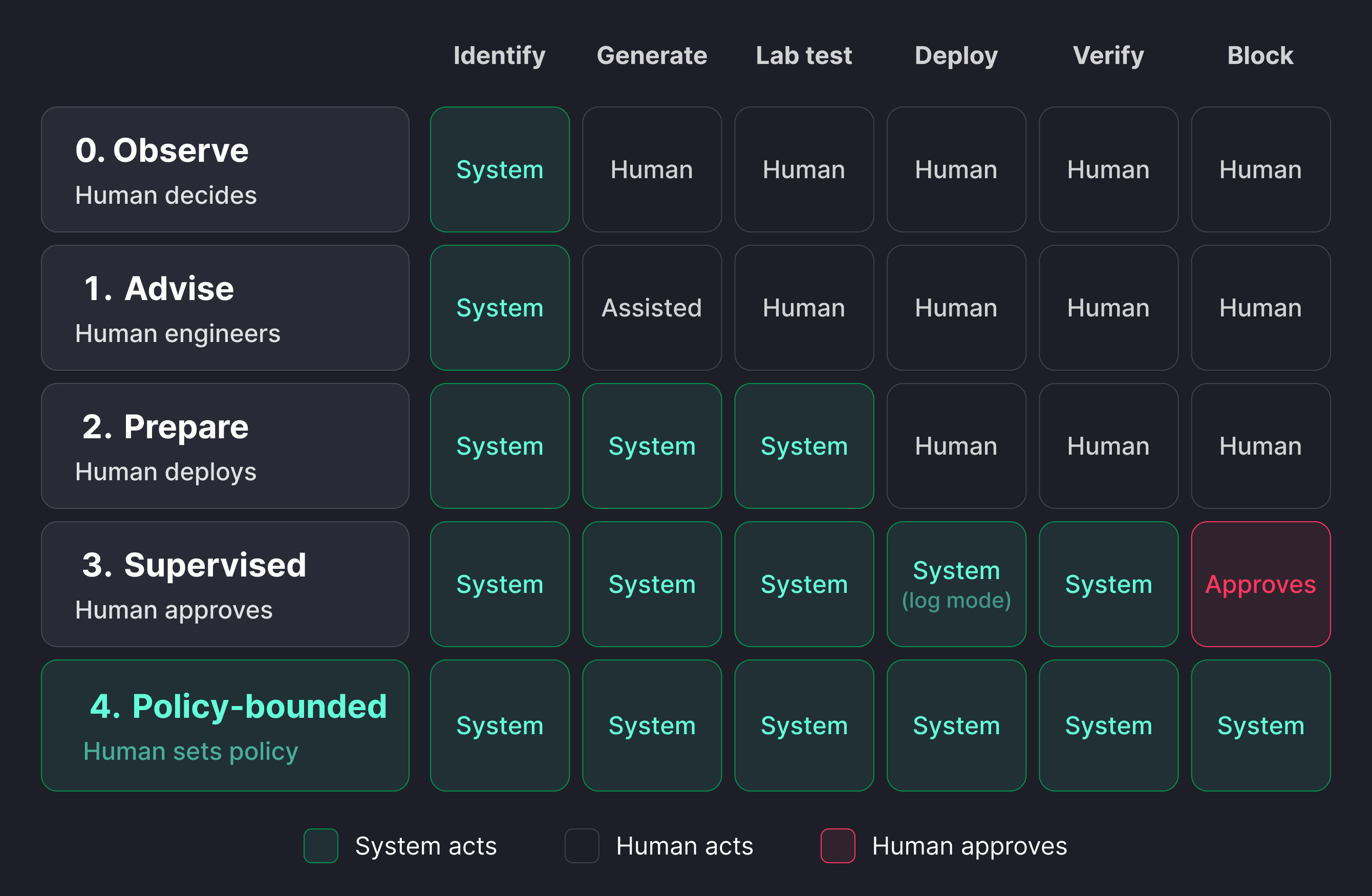
Autonomy is not a switch you flip. Rather, it is a path that security teams will need to walk - movingforward as they gain trust in the autonomous system. The path is in many respects similar to theone self-driving cars took. No one put a car with no steering wheel on the road on day one.Automation arrived one capability at a time: cruise control, then lane-keeping, then supervisedself-driving in defined conditions. Each step was earned by a safety record, and the driver stayed incontrol until the evidence said they no longer had to. Autonomous Mitigation follows the same path,for the same reason: acting on production has to be earned, not assumed.
The automotive industry describes this with levels of driving automation (SAE L0–L5). The same frameworkcan be used for Autonomous Mitigation, where change from one level to the next is not determined by howcapable the machine is, rather, it is who holds the wheel, and what the human is responsible for.
An Autonomous Mitigation system must be capable of Level 4, but the organization decides whereto use it. Autonomy is granted per scope, such as an asset class, a vulnerability type or a control,not switched on for the whole environment at once. A team might run Level 4 on internet-facingservices, Level 3 on payment flows, and Level 2 on legacy systems. Each scope moves up a level byevidence, once the system has built a record of verified mitigations that blocked every exploitwithout disrupting legitimate traffic.
There is deliberately no Level 5. Unlike a self-driving car, a mitigation system should never operatewithout policy bounds. Humans always set the rules, and the system acts within them at machine speed.

Does your organization's security program need Autonomous Mitigation capabilities?

The answer is ‘Yes’ if any of the following apply:
Critical vulnerabilities stay exploitable while fixes move through testing, release, orchange windows;
Security depends on other teams to engineer and deploy every patch andcompensating control;
You rely on WAFs, gateways, runtime, IAM, or network controls but can’t prove theystop the exploit;
Scanners, pentests, bug bounties, and threat intel surface findings faster than youcan protect against them.

Assess your window:

Measure your TTVM
Measure median and P90 from validated critical finding to provably-closed path.
Audit engineering dependence
Count how many critical exposures need handcrafted controls from other teams.
Map enforcement points
Map where you can rapidly enforce, and whether you can programmatically verifyefficacy against a live exploit
Set policy guardrails
Start with low-friction, reversible mitigations on non-critical assets, then scale.

Achieving Zero Exploitability withMiggo Security

Miggo Security is on a mission to help organizations become Unexploitable Enterprises. Miggosolves for a single outcome: reducing the exploitability window to zero.
Miggo’s Autonomous Mitigation solution is built on three core principles:
Lever What it drives Function
Fewer windows open Paths that never become exploitable in the first place Preempt
Open windows close fast Duration from "this path can be exploited" to "verifiably shielded" Mitigate
An open window survives contact An attempt that lands does not become a breach Detect and respond
Fewer windows open:
What it drives: Paths that never become exploitable in the first place
Function: Preempt
Open windows close fast:
What it drives: Duration from "this path can be exploited" to "verifiably shielded"
Function: Mitigate
An open window survives contact:
What it drives: An attempt that lands does not become a breach
Function: Detect and respond
Whitepaper

Get the whitepaper

Closing the Exploitability Window
Free PDF, delivered instantly.
By submitting this form you agree to the processing of your personal data as described in our Terms and our Privacy policy.
Download PDF
Oops! Something went wrong while submitting the form.