For as long as there has been software, the answer to a new vulnerability has been the same: wait for the patch, test it, roll it out. That cycle takes weeks, often months. Attackers used to need time too, to read the advisory, understand the bug and build an exploit. AI is taking that time away from them, and the stretch between a vulnerability going public and the patch landing has become the most dangerous window in security.
This week, two of the biggest names in technology stepped into that window. OpenAI and Cisco released Shirudo, an open-source runtime that loads small protections, which the project calls shields, into running Linux machines, with OpenAI's Codex writing them. Their message is the one Miggo was founded on: you can't patch your way out of AI-speed exploitation. You have to mitigate first.
Turning new CVEs into runtime protections is what we do every day, so we did more than read the announcement. We pointed our own CVE mitigation pipeline at Shirudo, generated shields for two vulnerabilities its launch didn't cover, and ran them against real exploits. Before the results, here is how we see the release.
Our take: the shield is the last step in a longer chain
Shirudo solves a real problem well. Once you know what to block, it gets that protection onto every host within about a minute and keeps an attacker with root on the host from quietly removing it. Signed, attested delivery of kernel code is hard to build, and the project deserves credit for it.
But a shield is the last step in a longer chain. Before it, someone has to research where the vulnerable code fails, decide whether it matters in your environment and build the mitigation. After it, someone has to prove the shield stops the exploit without breaking the application, and keep proving it as the application changes. Shirudo leaves that chain to whoever writes the shield, and that work is what separates a demo from a defense. Our new research, Prompted vs. Proven: Five Frontier Models Against Miggo's Mitigation Lab, found the same gap with WAF rules: a model can write a rule, but a proven process is what makes it safe to ship.
Shirudo also adds one more place to enforce a mitigation, on the host. For Miggo, that is one more output: the same pipeline that ships WAF rules and sensor rules can ship Shirudo shields, as the rest of this post shows. Every new control makes the decision layer more valuable: what to mitigate, where, and how to keep it effective.
And it is early. OpenAI calls Shirudo "a first step," and its showcase result is one controlled test. Enterprises need mitigation that is proven safe, scalable and supported in production. Unless a team wants to build and maintain its own library of shields, most will get this from a vendor. Miggo does this in production today.
How we built the experiment
At Miggo we run a CVE mitigation pipeline. When a new CVE comes in, it researches where the vulnerable code fails, builds a lab with the vulnerable application, working exploits and normal traffic, and generates a mitigation that it tests against both. The pipeline ships those mitigations as rules for WAFs and for the Miggo sensor.
Shirudo gave us a new target for the same pipeline. We wanted to challenge ourselves, so we added an adapter that turns the pipeline's output into Shirudo shields and tried it on two CVEs that Shirudo's own demo didn't cover.
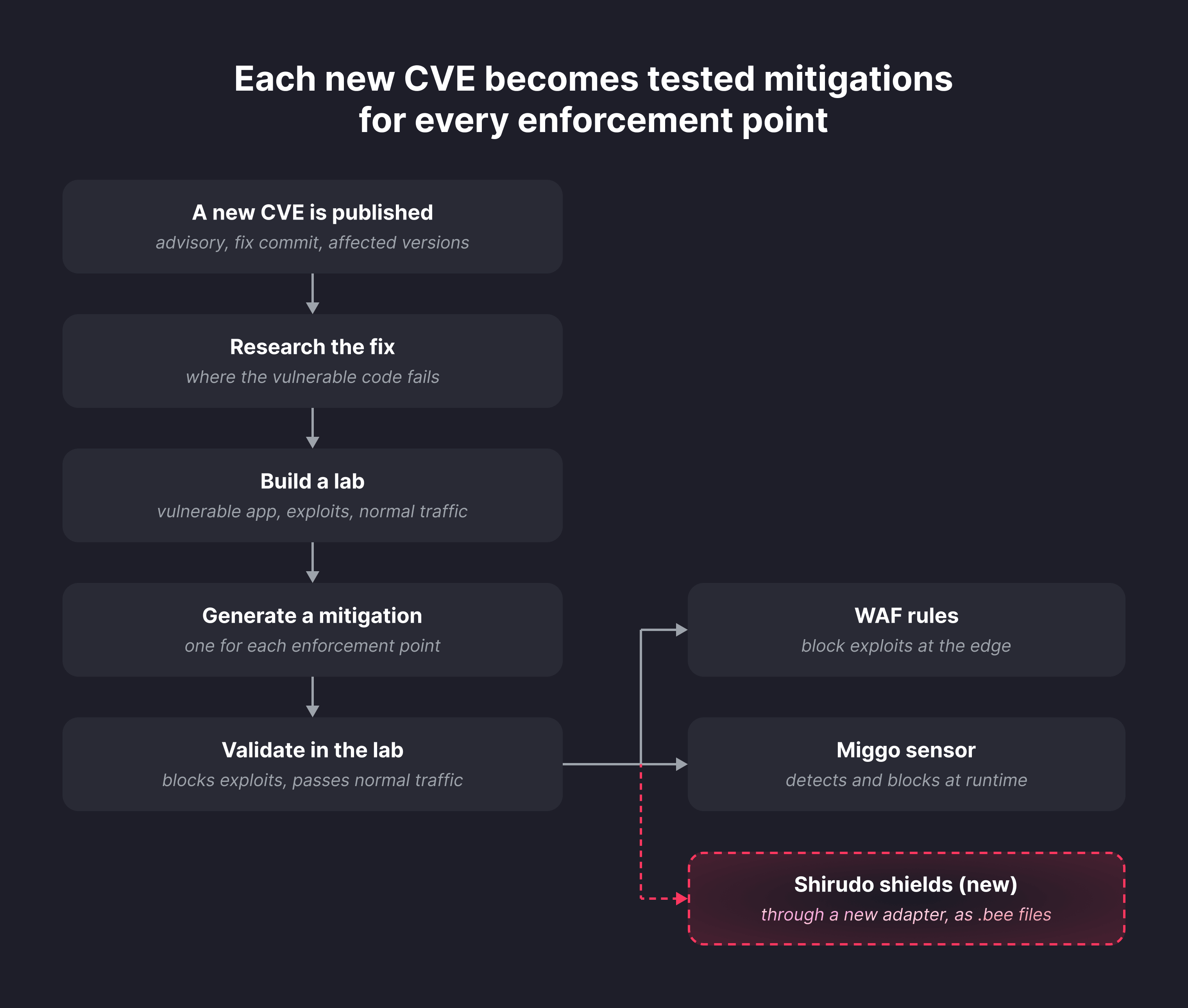
The dashed branch is the new part. Everything before it is the same pipeline we already run for WAF rules and the sensor.
What Shirudo is
Shirudo is an open-source runtime from OpenAI and Cisco's Isovalent team that loads small mitigations, which the project calls upatches, into running Linux machines without a reboot (Isovalent). Runtime protection on Linux has usually meant detection engineers writing policies for engines like Tetragon or Falco, and Shirudo replaces the policy with code that an AI agent is expected to write.
An upatch comes in one of two forms:
- A BPF program attached to a kernel hook, which can refuse an operation such as starting a program, opening a socket or creating a namespace, or count it for telemetry.
- A Java agent that changes bytecode inside the JVM, which can add a check to a vulnerable method.
The operator signs each upatch and packages one or more of them as a .bee file, together with the CVEs it fixes and the machines it applies to, then pushes the package to an OCI registry, the same kind of registry that stores container images. Each host runs a small command on a systemd timer, about once a minute by default, which pulls new packages, checks their signatures, loads them and exits, so no Shirudo daemon stays running (Shirudo docs). After boot, the kernel accepts BPF only from loaders signed with the operator's key, and the TPM records every load, so an attacker with root on the host can't quietly remove a shield.
Running it takes a bpf-next kernel with Shirudo's own patches, a TPM and a custom boot chain (system requirements), so we ran it in the project's test virtual machine on an EC2 instance.
A kernel CVE: CVE-2024-1086
Shirudo's repository ships kernel samples for bugs in the AF_ALG crypto interface, the IPv6 routing header and two drivers, so we picked one it doesn't cover. CVE-2024-1086 is a double free in the kernel's nf_tables component that lets a local user become root, and CISA added it to its Known Exploited Vulnerabilities catalog in May 2024, later marking it as used in ransomware campaigns (BleepingComputer, Sysdig).
The public exploit reaches nf_tables through an unprivileged user namespace, which gives an ordinary user network-admin rights inside that namespace (CrowdStrike). Our research step chose that dependency as the mitigation point, which matches Red Hat's advice for unpatched systems to disable user namespaces, with the caveat that container platforms need them (Red Hat).
The adapter turned the mitigation into a short BPF program on the LSM hook that runs when a process asks for a new user namespace. It refuses the request when the caller has no admin rights on the host and isn't one of the container runtimes on an allowlist, and it counts each refusal.
Shirudo's test kernel is a recent bpf-next build that already contains the fix, so the exploit can't succeed there with or without the shield, and the same holds for the kernel samples in Shirudo's repository. In the lab, the shield refused the exploit at the namespace step it depends on, and containers on the host started normally. Anyone reading the counts should know that the shield records attempts rather than successful exploits, and legitimate tools that create user namespaces trip it too, so a count needs more context before it becomes an alert.
A Java CVE: Log4Shell
Shirudo's launch demo used a Java agent against Java4Shell, a bug in OpenJDK's Base64 decoder, so we took the best-known Java vulnerability instead. Log4Shell (CVE-2021-44228) lets an attacker who gets a crafted string into a Log4j 2 log message make the JVM look up and load code from a remote server through JNDI.
When Log4Shell broke in December 2021, the Amazon Corretto team shipped a hotpatch built the way a Shirudo Java upatch works. Their Java agent rewrites JndiLookup.lookup() in every loaded copy of Log4j so that it returns a fixed string instead of performing the lookup (AWS). Our pipeline generated the same kind of agent, the adapter packaged it as a Java upatch in a .bee file, and in the lab the exploit's lookup returned the fixed string while normal logging kept working.
The two differ in when the agent arrives. Corretto's tool injected its agent into JVMs that were already running (GitHub), while Shirudo's Java upatches load only into JVMs that start after the shield is installed, so a running service picks up the fix at its next restart (Shirudo docs).
What we think comes next
The obvious next step is attaching Java shields to JVMs that are already running, as Corretto's Log4Shell hotpatch did through the JVM's attach API, so a fix doesn't have to wait for the next restart. After that, application-level shields should reach more runtimes, such as Python and Node.js, where an agent loaded at startup can wrap a vulnerable function with a check on its input, much as a Java agent rewrites a method. We expect the performance cost to be close to a Java agent's, since each adds a check to the functions it patches and leaves the rest of the code alone.
A patch on the vulnerable function covers one CVE at a time and sees only what happens inside the application, while a kernel shield sees what the process does to the system but not why it does it. Our CVE-2024-1086 shield showed that gap, because it counted namespace requests without knowing whether any of them came from an attack.
At Miggo we connect the two views. The sensor sees a process start a shell or open a connection, and it also sees which code path in the application led there, so a detection can say both what happened and why. We think runtimes like Shirudo will need that link between the application and the operating system to turn a count of risky operations into detections people can act on.
The bottom line
Shirudo is good news for defenders. It pushes the industry where it needs to go, from waiting on patches to mitigating at runtime, at machine speed.
Our experiment showed why the chain matters more than the shield. Adding Shirudo as a target took one adapter, because the hard parts were already running in our pipeline: the research, the lab with working exploits and normal traffic, and the testing. It also showed the gap no single layer closes. A kernel shield sees what a process does but not why, and a patched function sees only its own CVE. Connecting the two is what turns a count of risky operations into a decision you can act on.
Miggo runs that full chain in production today, for WAF rules and the Miggo sensor: finding which vulnerabilities matter in your environment, generating the mitigation, and proving it blocks the exploit without blocking legitimate traffic. As this experiment shows, the same chain extends to new enforcement points like Shirudo with an adapter.
Want to see what that looks like in your stack? Send us your CVE list. We'll show you which vulnerabilities are reachable in your environment and which ones we can mitigate today. Talk to our team.