

TL;DR
- Survey of 900+ security leaders shows runtime is the breach battlefield
- Even pre-production controls are not stopping known vulnerabilities in the AI age, as 82% of organizations lack real-time visibility into AI runtime behavior.
- Infographic of the findings can be found below
Miggo Security, along with the Cloud Security Alliance (CSA), the world's leading not-for-profit organization committed to AI, cloud, and Zero Trust cybersecurity education, has released the 2026 State of Modern Application & AI Security Report.
.png)
Built on survey data from more than 900 cybersecurity leaders, the report exposes a structural failure in enterprise security: organizations have invested heavily in pre-production scanning and "Shift-Left" tooling, yet known vulnerabilities are still reaching production and becoming incidents. In a post-Mythos era, AI has shrunk exploitation windows and organizations must reduce exposure with remediation underway to keep pace.
The findings challenge the assumption that earlier detection alone can keep pace with modern application and AI risk. Discovery may start before deployment, but protection increasingly has to continue after applications are live. Runtime visibility and mitigation are becoming the missing layer between knowing a vulnerability exists and preventing it from becoming an incident.
“Organizations have made meaningful progress in shifting security earlier in the development lifecycle, but this research suggests that identifying vulnerabilities is only part of the equation,” said Hillary Baron, AVP of Research, Cloud Security Alliance. “The real challenge begins once applications are in production, where security teams must rapidly determine which exposures are truly exploitable, prioritize the risks that matter most, and respond before attackers can take advantage. As AI-driven applications introduce more dynamic behavior and threat actors continue to accelerate exploitation timelines,the ability to determine what's genuinely exploitable and act on it quickly is becoming the central operational challenge in application security.”
"AI is not just creating more vulnerabilities. It is exposing the fact that companies cannot fix known vulnerabilities fast enough,” said Daniel Shechter, CEO and Co-Founder of Miggo Security. “For years, security programs have been measured by how well they find risk before software goes live. Frontier AI like Mythos changes the question. If attackers can move from disclosure to exploit in hours, boards and CISOs need to understand how long the business remains exposed, and what can be done to mitigate quickly and efficiently.”
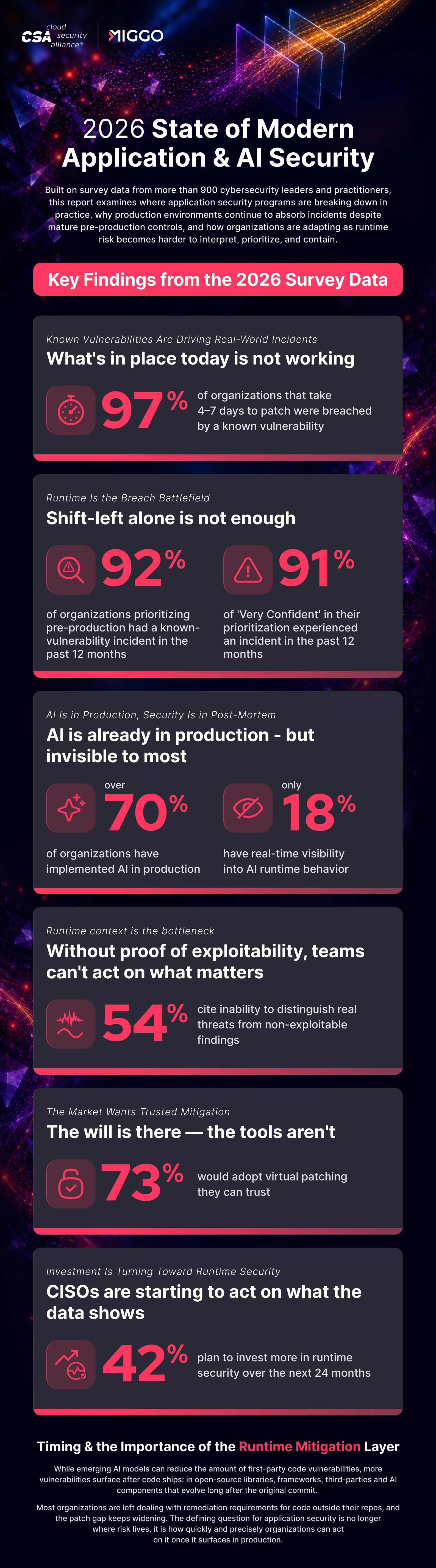
Infographic summarizing the 2026 State of Modern Application & AI Security Report based on a survey of 900+ cybersecurity leaders. Key findings include: 97% of organizations taking 4–7 days to patch experienced a known-vulnerability breach; 92% of organizations prioritizing pre-production security still experienced incidents; only 18% have real-time visibility into AI runtime behavior; 54% struggle to distinguish real threats from non-exploitable findings; 73% would adopt trusted virtual patching; and 42% plan to increase investment in runtime security over the next 24 months.
Key Findings from the 2026 Survey Data
The report highlights a clear disconnect between vulnerability detection and actual runtime protection:
Known Vulnerabilities & the Patch Gap Are Driving Real-World Incidents
Across all respondents experiencing a production incident, nearly half say it involved a vulnerability their security team had already identified before release. Only 9% of organizations remediate critical or high-severity vulnerabilities in production within 24 hours, while 74% take between 1 and 7 days.
Longer patch cycles correlate with significantly higher incident rates
Organizations in the 4-to-7-day capability were breached by a known vulnerability at a 97% rate, compared to 77% among those who patch within 24 hours.
Runtime Is the Security Incident Battlefield & Pre-Production Investment Has Not Closed the Gap
92% of organizations prioritizing risk identification before deployment experienced a known-vulnerability incident in the past year, while 91% of those who reported they were “very confident” in their organization's AppSec strategy still had a production incident bypass pre-production controls.
AI Is in Production, Security Is in Post-Mortem
70% of organizations have AI-powered components in production, yet 82% cannot see AI runtime behavior in real time.
Closing the Gap Requires Trusted, Immediate Mitigation, i.e., Virtual Patching
73% of respondents would adopt virtual patching that could reliably block production exploits with minimal false positives.
Investment Intent Is Turning Toward Runtime Security
The structural conditions described in the survey are actively shaping budget decisions for H2 2026. According to the report, 42% plan to invest more in runtime security over the next 24 months, a clear signal that CISOs are starting to act on what the data describes.
The survey was conducted in January 2026, before Mythos demonstrated machine-speed exploitation and Anthropic released its security guide, naming "Close the Patch Gap" as its #1 recommendation for defending against AI-accelerated offense. The CSA report reveals that the missing layer of runtime mitigation, guided by exploitability evidence, is moving from analyst recommendation to budgeted priority.
Timing & the Importance of the Runtime Mitigation Layer
While emerging AI models can reduce the amount of first-party code vulnerabilities, more vulnerabilities surface after code ships: in open-source libraries, frameworks, third-parties and AI components that evolve long after the original commit. Most organizations are left dealing with remediation requirements for code outside their repos, and the patch gap keeps widening. The defining question for application security is no longer where risk lives, it is how quickly and precisely organizations can act on it once it surfaces in production.
To download the full 2026 State of Modern Application & AI Security Report, click here.
.webp)